
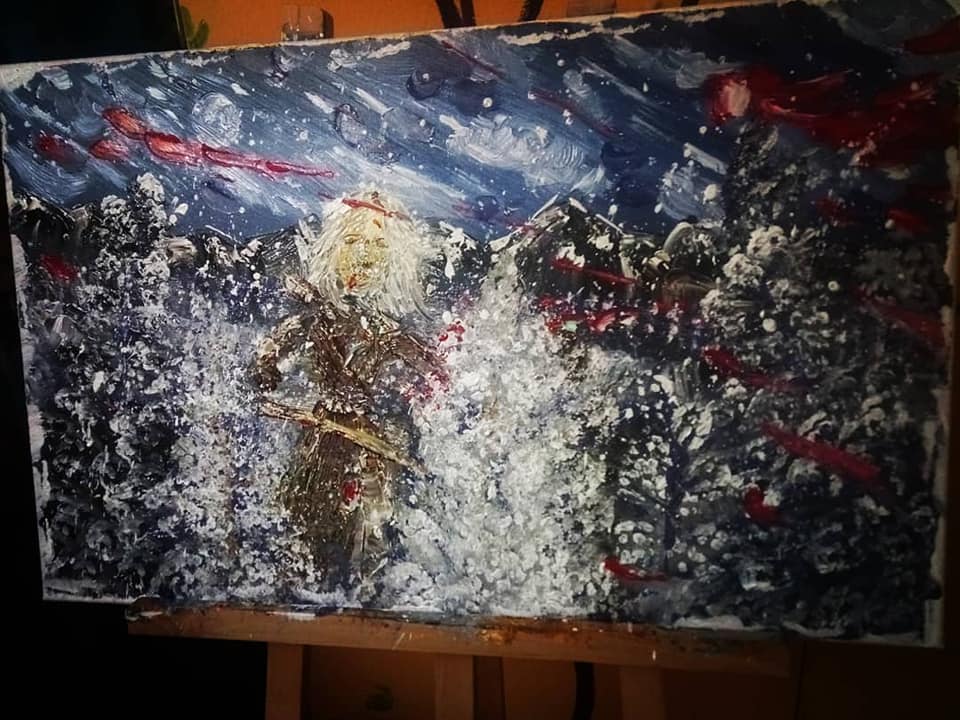
Dragonfly Traveling.
"That's an interesting painting, isn't it? It's one of my commissioned paintings. But I mean – it's not like I sold it. It's meant more in the sense that I was learning to work on commission. That I communicated the theme with another person: A female samurai. A forest. What kind of forest? At night? In winter? A katana? Curved upward?
Another aspect of my painting is the fact that I am somewhere at the beginning. I am discovering the rules of acrylic painting. How fast do the colors dry? How fast can I apply the colors? How early or how late can I blend acrylic paints? How to paint clouds? And then, for instance, perspective. In the painting Dragonfly Traveling, I wanted to slightly tilt the horizon to emphasize the Dragonfly's movement. And if I want to paint a blizzard, the painting flattens out – but now I've confirmed with my own eyes that when I look into a snowstorm – it really is as if the whole image flattens out for me.
Dragonfly is the name of that female samurai's katana – but it is actually her name as well – hence Dragonfly Traveling. And then there is the story of that Dragonfly – who has already flown over the mountains and is now skimming the treetops, carving her way with her katana – but she has also already sustained some injuries. Some of them are quite fresh. It looks as though she is running away, yet at the same time she is sailing toward her Destiny. Determined, strong, resilient. She has a stubborn expression.
In this painting, I also learned how a painting changes – when a person looks at it in daylight, at night by indoor lighting, from the left, from the right. The Dragonfly changes her expression. And yes, on her chest she has a dragonfly, a bronze-green dragonfly… which is pierced by illusion so that the heart sees only the truth.
The inspiration for this painting was undoubtedly the film House of Flying Daggers, only I swapped the bamboo for pines and spruces. At the end of the film, there is a very captivating combat sequence, ending in heavy snowfall, where blood flies in all directions – and I carried that over into this painting as well.
It's interesting where a commission takes you – because it took me precisely to where I needed to go – House of Flying Daggers was important to me at the time, and for a long time afterward I hummed the song Jia ren qu:
Chinese song title: Jia Ren Qu 佳人曲
English song title: Song For The Beauty
Sung by: Li Yu Gang 李玉刚
Composed by: Mei Lin Mao 梅林茂 Shigeru Umebayashi
Written by: Li Yan Nian 李延年
Song to listen to here.
Jia Ren Qu 佳人曲 Song For The Beauty Lyrics 歌詞 With Pinyin By Li Yu Gang 李玉刚
In the north there is a beauty
北 方 有 佳 人
There are good people in the north.
jué shì ér dú lì
绝 世 而 独 立
The world is dead and independent
yí gù qīng rén chéng
一 顾 倾 人 城
One care, the city of people
zài gù qīng rén guó
再 顾 倾 人 国
Then care about the people of the country
níng bù zhī qīng chéng yǔ qīng guó
宁 不 知 倾 城 与 倾 国
Rather not knowing the city and the country
jiā rén nán zài dé
佳 人 难 再 得
Good people hard to get again
In the north there is a beauty
北 方 有 佳 人
There are good people in the north.
jué shì ér dú lì
绝 世 而 独 立
The world is dead and independent
yí gù qīng rén chéng
一 顾 倾 人 城
One care, the city of people
zài gù qīng rén guó
再 顾 倾 人 国
Then care about the people of the country
níng bù zhī qīng chéng yǔ qīng guó
宁 不 知 倾 城 与 倾 国
Rather not knowing the city and the country
jiā rén nán zài dé
佳 人 难 再 得
Good people hard to get again“
The painting „Dragonfly on the Path“ presents a unique fusion of traditional Japanese themes and modern artistic expression. The work depicts a female samurai forcing her way through heavy snowstorms in a winter landscape, which evokes a sense of a lonely journey and relentless struggle.
Technique and color palette The author uses raw and dynamic acrylic brushstrokes to portray the harsh winter atmosphere. Blue and grey tones dominate with striking red accents, symbolizing blood and combat. The horizon is slightly tilted, emphasizing the female samurai's constant movement and uncertainty on her journey.
Symbolism and interpretation The title „Dragonfly“ refers to the female samurai's katana, but also to her nickname. In Japan, the dragonfly is a symbol of victory and strength, reflecting the character's determination and resolve. The dragonfly can also symbolize the female samurai's ability to adapt to changing circumstances and overcome obstacles.
This painting illustrates how the artist combines personal experience and technical skill to present not only a visual story, but also a deeper emotional and philosophical layer that resonates with the viewer on multiple levels.
This painting already has its owner.
Do you like my painting and want to support me as a painter?
Painting with signature: Rajneesh Pranapati















