ENDRALON.SPACE

ANTONÍN DELIŠ · HEAVY CONTEMPORARY ARTIST

GUIDE ↗
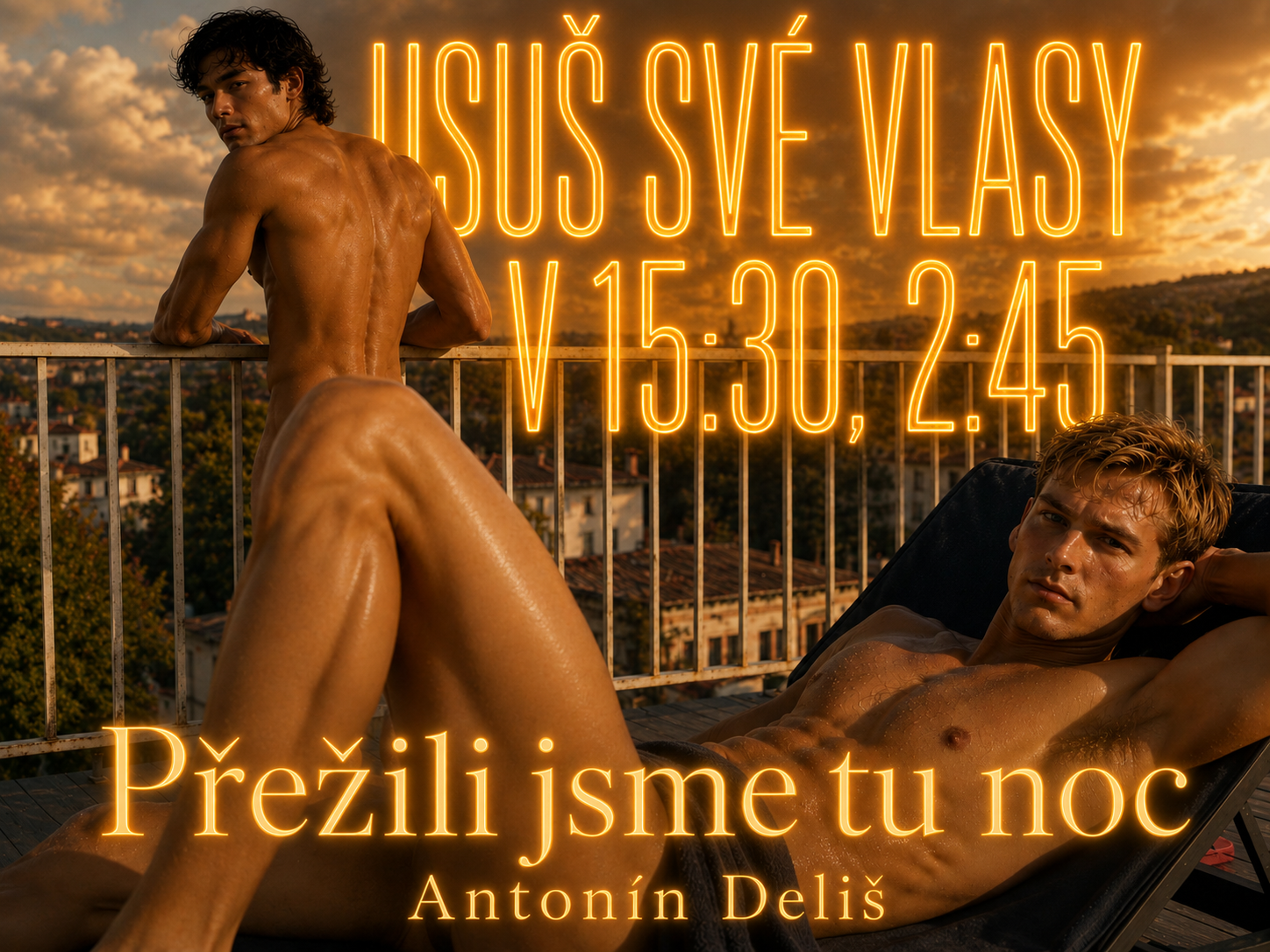
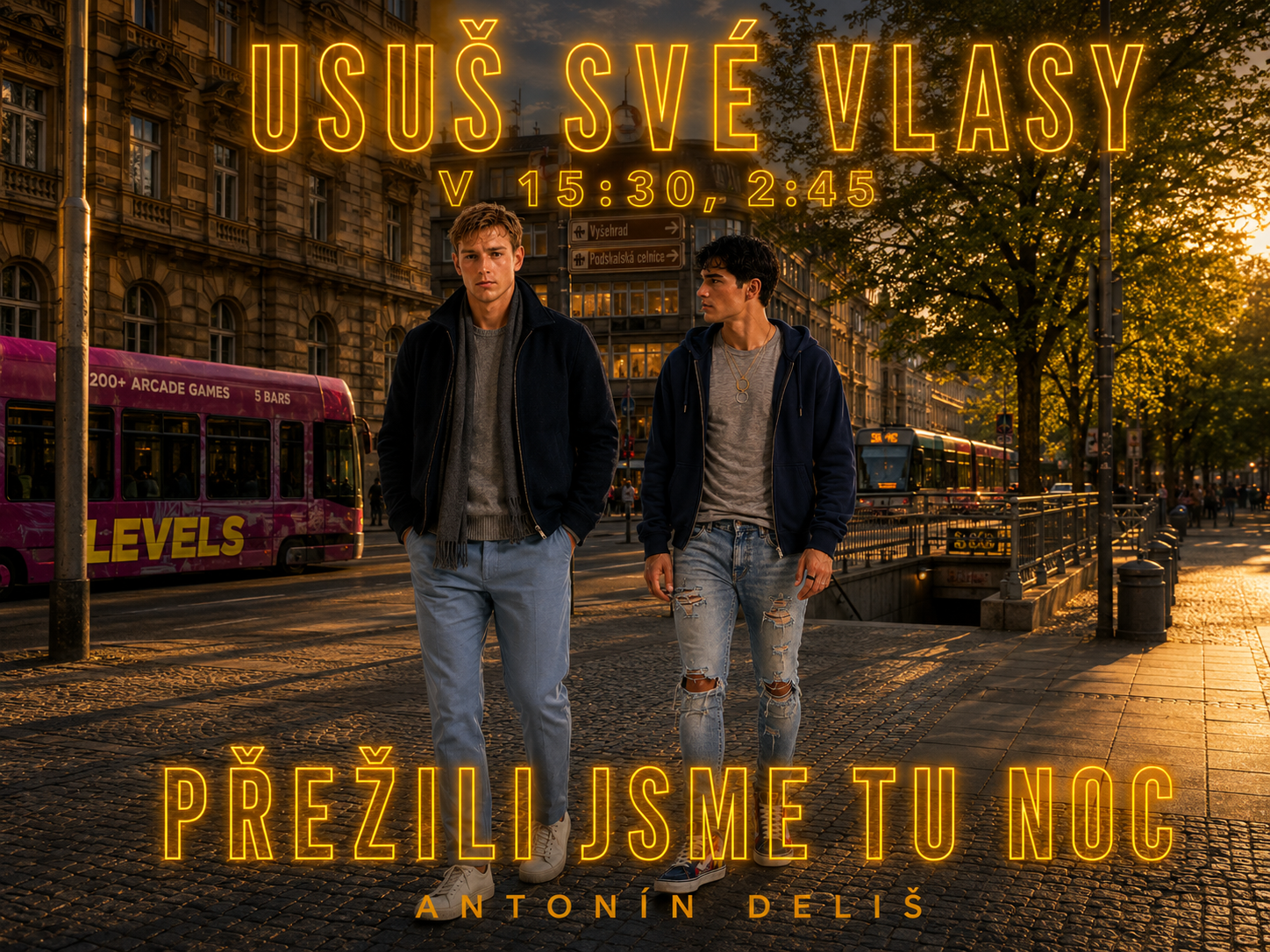
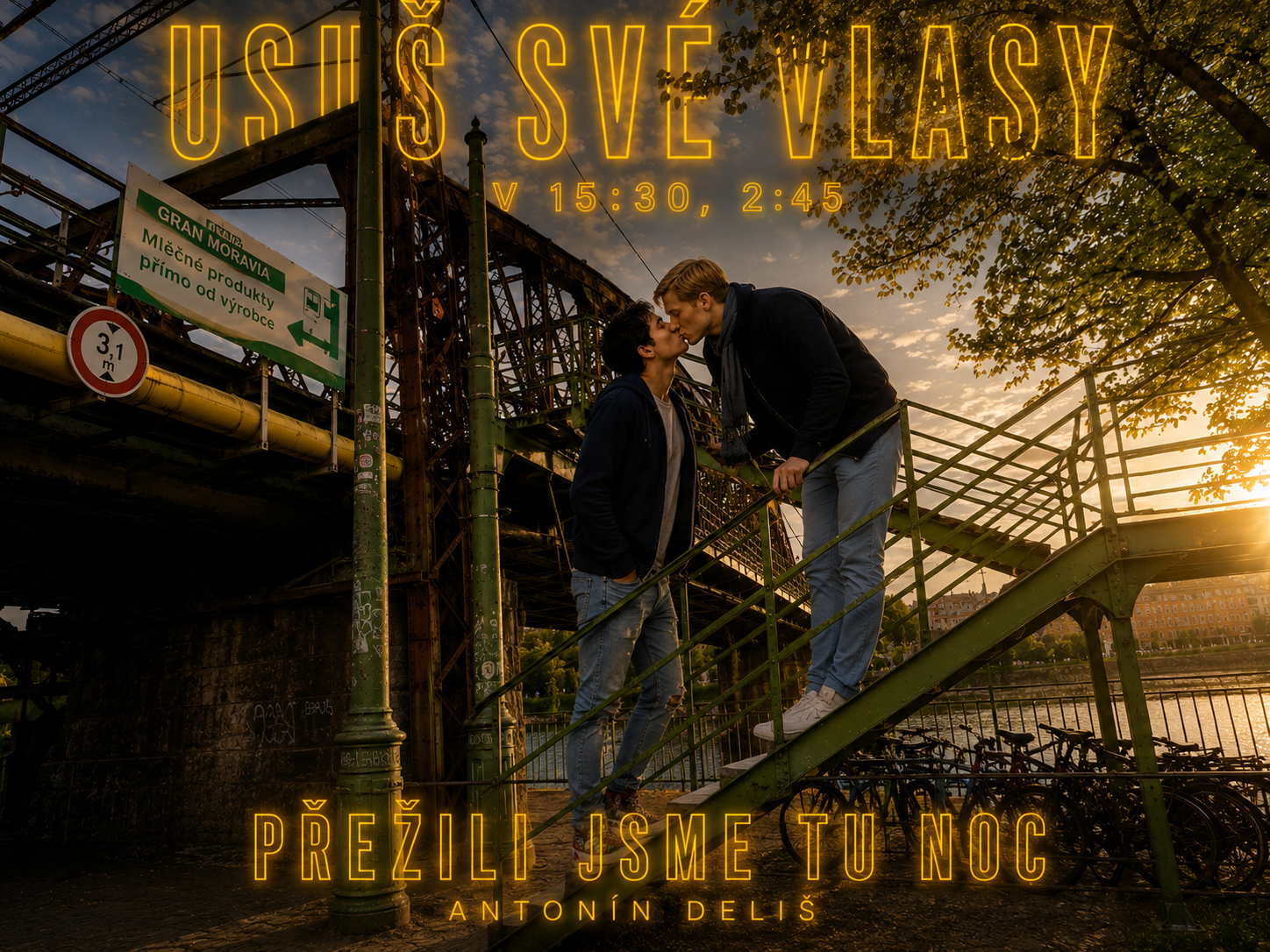
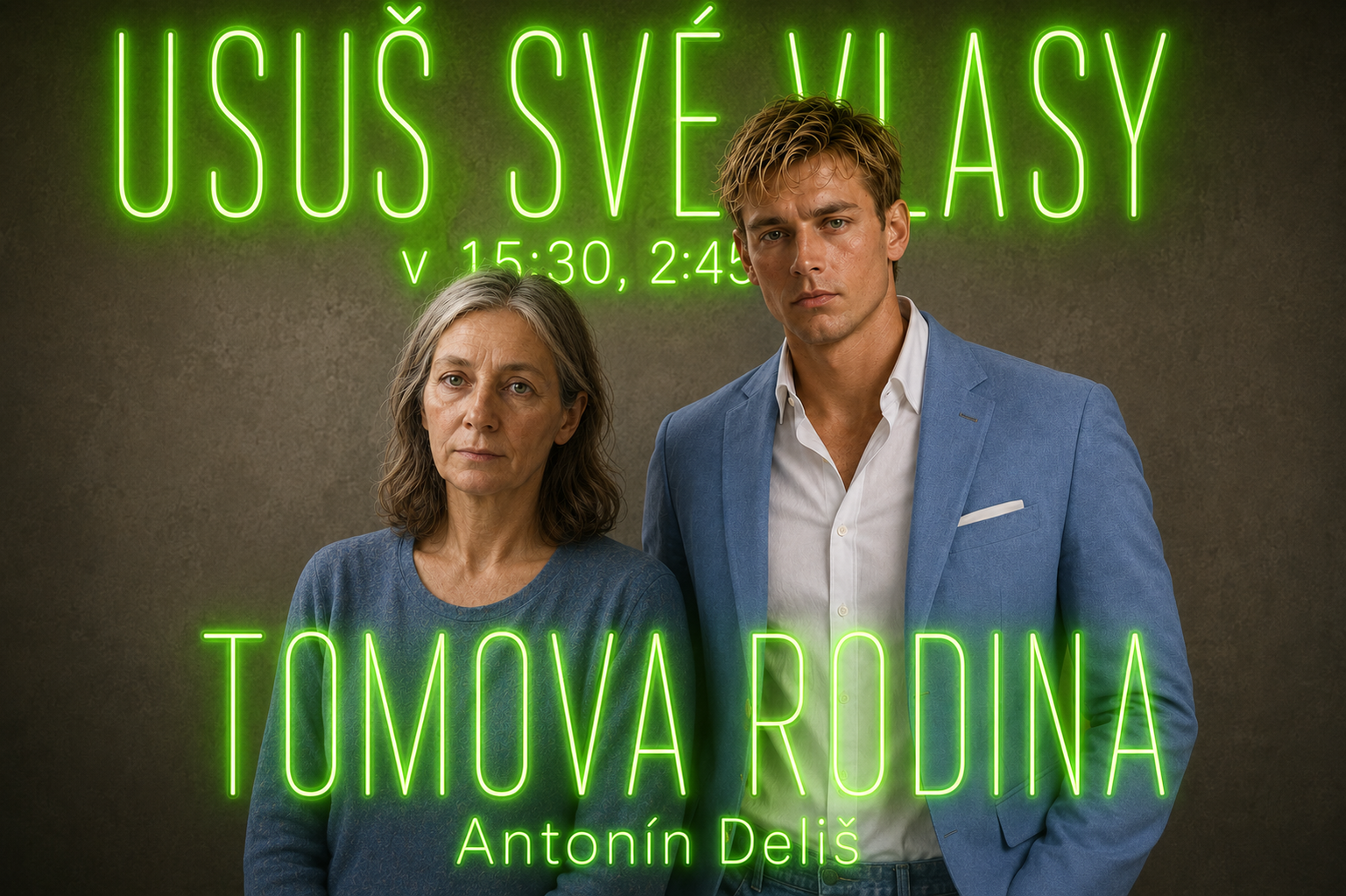
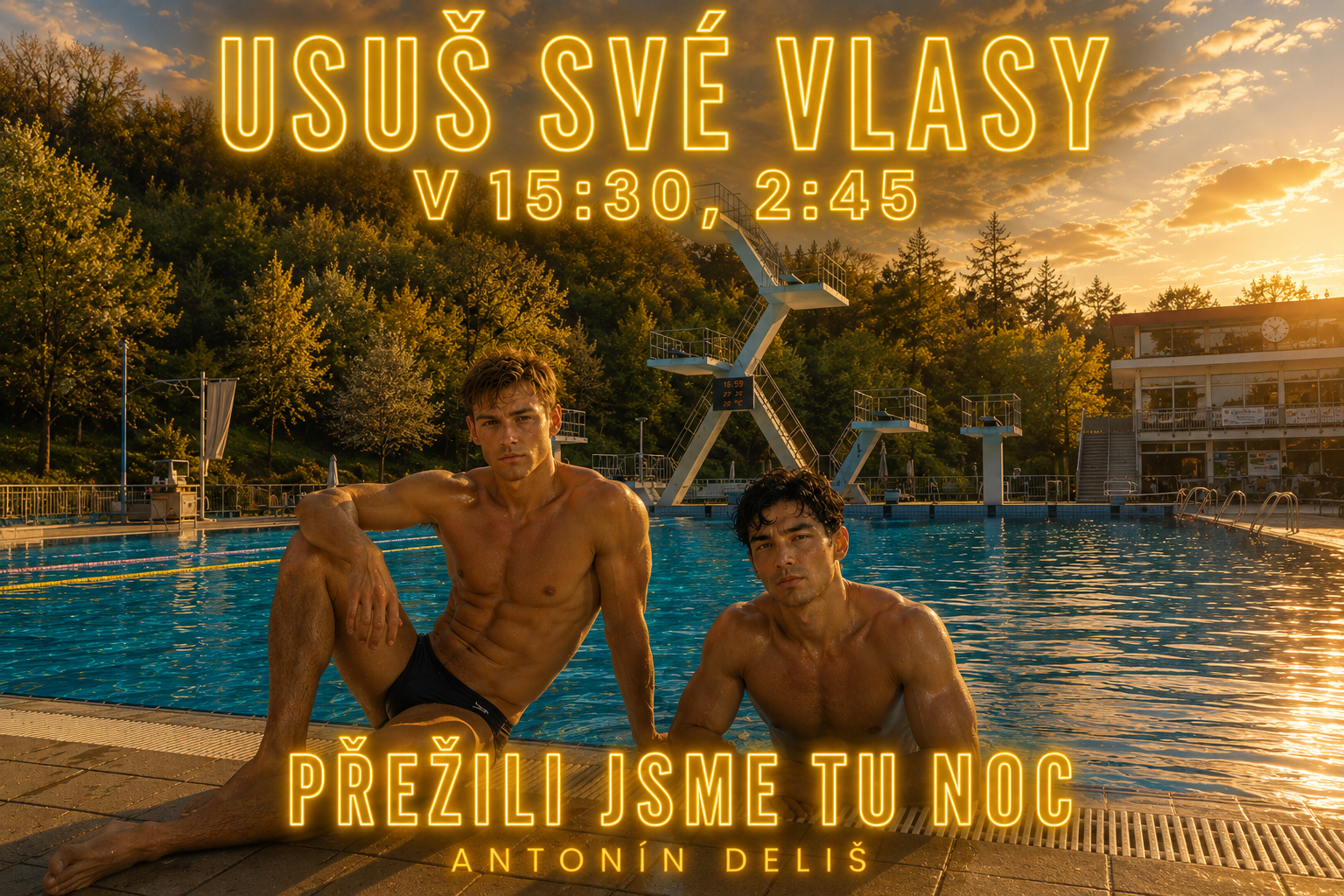
Usuš své vlasy v 15:30, 2:45 — IV. díl Přežili jsme tu noc, oficiální obálka

HEAVY CONTEMPORARY GAY ROMANCE · IV. DÍL PENTALOGIE

Přežili jsme tu noc

Usuš své vlasy v 15:30, 2:45
Antonín Deliš

Jarní pokračování pentalogie o Tomovi a Viktorovi, o vzpomínkách, rodinné paměti, truchlení a blízkosti po noci, která všechno změnila.

PŘIPRAVUJE SE K VYDÁNÍ

VSTUP DO SVĚTA KNIHY

Vyber si, kudy vstoupíš

Čtvrtý díl pentalogie se připravuje. Zatím objevuj příběh, soundtrack a jeho vizuály.

Vstoupit do příběhuO KNIZEForendorsČTENÍ · SLEDOVATWattpadČTENÍ · SLEDOVATSpotifySOUNDTRACKVinylHUDEBNÍ VYDÁNÍDatabáze knihKARTA KNIHY
Kniha u partneraPŘIPRAVUJE SE
E-knihaE-KNIHA · PŘIPRAVUJE SE
AudioknihaAUDIOKNIHA · PŘIPRAVUJE SE

OFICIÁLNÍ TRAILER PENTALOGIE

Usuš své vlasy v 15:30, 2:45

Oficiální trailer celého pětidílného příběhu.

Videoklipy a vizuály ke čtvrtému dílu ↗

O KNIZE

Na první pohled

ÚVODNÍ POVÍDÁNÍ O KNIZE

Vstup do příběhu

Spring brings light back to Prague, the first leaves, and air that is no longer freezing. Podolí is filling up with people again, and the city feels as though it is slowly returning to normal life. Yet the people walking through it are no longer the same as they were before the winter.

Tom tries to go to school, work, take care of Romi, and convince himself that there are days when he doesn't have to think about the past. Viktor continues training, but his body reacts with panic attacks, waking up at night, and moments where he loses certainty for a few seconds about where he actually is.

Přežili jsme tu noc is a story of returns that do not lead back to the same place. Tom and Viktor meet again in a space full of memories, family silence, old photographs, changed names, and stories of people who were never spoken of at home. Some pains did not begin with them. Yet they must decide whether they will carry them further in the same way.


SVĚT KNIHY

Čtvrtý pohyb pentalogie

The first part was heat. The second part was a grip. The third part was frost. The fourth part is the silence after the storm.

The conflicts haven't disappeared, they've only changed form. They no longer come primarily as arguments and open clashes, but as memories, reproaches, and questions that return in the middle of the night when a person cannot sleep.

Přežili jsme tu noc shifts the pentalogy from a story of relationships to a story of transformation. Tom and Viktor move through the same city, around the same water, and in places they knew before, but they themselves enter them differently now.

In the fourth part, the narrative changes as well. Reality intertwines with dreams, memories, and symbolic images without leaving the real world. That is precisely how the past returns: in voices, faces, and nights that sometimes feel more real than the day.


HLAVNÍ POSTAVY

Čtyři postavy jednoho jara

Tom Záhorský

Tom Záhorský

Tom tries to return to school, work, caring for Romi, and his normal routine, but he can no longer silence his memories with harshness or irony. The exhaustion he has hidden for so long is becoming more visible. He is learning to accept help and admit that closeness does not have to mean weakness or the loss of his own freedom.

Viktor Polesný

Viktor Polesný

Viktor seems calmer, but his body is reacting differently than before. Panic attacks, insomnia, and moments of inner disconnection show that running away has stopped working as a solution. His journey is therefore slowly changing: from the need to disappear to the possibility of staying, returning, and not automatically seeing closeness as a threat.

Tony Leung

Tony Leung

Tony remains one of those characters whose influence cannot be separated from the development of Tom, Viktor, or the entire world around Podolí. His manner of presence, relationships, and decisions continue to shape how others understand tenderness, responsibility, and what people leave behind in one another.

Veronika Coufalová

Veronika Coufalová

Veronika continues on her own path outside the main focus of Tom and Viktor's story. She is still dealing with performance, caregiving, and the need to manage everything, but she is gradually discovering relationships where she does not have to be the only person holding the whole world together.

DALŠÍ POSTAVY ČTVRTÉHO DÍLU

Další postavy

The fourth installment is more intimate, but its family background expands. Romi, Sršeň, and Oli are not just relatives of the main characters: their memories, silence, and personal growth open up a history that began long before Tom and Viktor. Old names, photographs, stories of the dead, and people who were long kept unspoken of at home are added to the mix.


Originální ilustrace knihy Přežili jsme tu noc — Další postavy

SVĚT KNIHY

Místa příběhu

Spring Prague · Podolí · diving tower · locker rooms, showers, and drying room · Gorazdova · Vltavská · Dlážděnka · SAPA · FTVS · embankment · night Prague · bathroom at 2:45

The fourth part returns to familiar places, but enters them much more deeply. Podolí is no longer just a sports venue or a place of relational tension. It is a space of memories. One only has to walk past the tower, enter the locker room, or catch the sound of water, and the past returns before a person can defend against it.

Prague also feels different. Spring brings light, the embankment, more open streets, and the first greenery, but the city is not cleansed of winter. Gorazdova, Vltavská, and other homes begin to reveal family stories, old photographs, changed names, and silences that existed long before the main characters were born.

The most intimate place in the installment is the bathroom at 2:45 AM. An ordinary room here becomes a space of the body, blood, closeness, and care. Some places gain significance by how many people pass through them. Others by what happens in them just once.


SVĚT KNIHY

IV. díl – Co v knize najdete

The fourth part represents the most intimate section of the entire pentalogy. It returns to spring Prague and the familiar setting of Podolí, but places a much greater emphasis on the inner world of the characters. The story connects everyday reality with subtle elements of magical realism, dreams, memories, and family history, without ever leaving the solid ground of the real world.

Panic attacks, mourning, identity transformation, name changes, and the question of whether one can start living again after a great loss come to the fore. Water plays a significant role as a space of purification, mutual care, touches that demand nothing, and the famous bathroom scene at 2:45 AM that gave the book its subtitle.

It is a story about the moment when a person realizes that some nights they do not survive through their own strength, but because someone stays beside them.


SVĚT KNIHY

Proč Přežili jsme tu noc

The title of the fourth installment does not refer to a single night or a single event. It speaks of a period after which a person is never the same again. Everyone experiences a night in their life during which a decision is made about what will remain and what will vanish forever. Morning may come, but the world no longer looks the same.

It is precisely such a journey that Tom and Viktor are going through. Their greatest adversary is not a specific person, but memories, fear, silence, and everything they carry forward, even though the surrounding world continues without them. Some pains cannot be overcome by force. They must be walked through. They must be survived.

That is why the title is in the plural. Přežili jsme tu noc. Not because both experience the exact same thing, but because some nights in a person's life do not have to be carried entirely alone.


SVĚT KNIHY

Jaro místo zimy

The third part ends with frost, steam rising over the pool, and a world where human warmth is scarcer than ever before. The fourth opens with spring: longer light, the first leaves, discarded jackets, runners along the Vltava River, and people returning to the riverbank. At first glance, it might seem like a relief.

However, spring alone heals nothing. Nature awakens faster than the human psyche, and familiar places remain full of what took place within them. Tom and Viktor return to the pool, the tower, the locker rooms, and the tram routes, but they do not look at them with the same perspective as before.

Therefore, in the fourth part, spring is not a symbol of a clean slate. It is a symbol of continuation. New leaves do not make last year's layers vanish; they merely cover them. It is this ambiguity that gives spring its power: it is not carefree, but fragile.


SVĚT KNIHY

Podolí jako paměť

Podolí has accompanied the pentalogy from the very first pages. In summer, it was a place of discovery; in autumn, a space of discipline; and in winter, a witness to pain and moments that no one can ever take back. In spring, its meaning transforms once again.

Every staircase recalls a different situation, a bench preserves an old conversation, and an ordinary locker can unlock an entire layer of the past. It is enough to smell chlorine, hear a body hit the water, or walk past a spot where something once happened. The memory returns before one has time to fight it off.

In the fourth part, therefore, Podolí is not merely a backdrop. It is silent, non-judgmental, and preserves everything that took place within it throughout the individual seasons. Places remember just like people, only they do not speak of their memories.


SVĚT KNIHY

Gay romance ve čtvrtém díle

Přežili jsme tu noc is the most intimate installment of the entire pentalogy. Following the events of the winter, Tom and Viktor cannot continue in the same way as before. Loss, exhaustion, fear, and everything that has hitherto remained unspoken between them enter their relationship. The surrounding world recedes into the background, and the story focuses primarily on two people drawing closer to each other at a time when neither has the strength to play their usual role.

Romance here does not unfold through conquest or grand gestures. It grows out of presence. Out of one staying when the other cannot breathe. Out of knowing when to speak and when simply to sit beside the other. Out of closeness meaning handing over water, drying a body, touching a foot, or holding someone at a moment when their vision of their own life is falling apart.

At the same time, Tom and Viktor carry a past that reaches further back than their first meeting. They gradually discover that their families, names, and old silences are more interconnected than they suspected. What arises between them is therefore not merely a personal relationship. It is also an attempt to step out of the stories that other people began writing for them long before they were born.

The most prominent love scene of the fourth part takes place in a bathtub at 2:45. It is neither the climax of a journey toward partner happiness nor confirmation that they will be together from this moment on. Physical closeness in it merges with fear, blood, water, and the awareness of how easily one can lose the other. It is a moment of complete surrender, after which no promise comes, but rather mutual care.

The fourth part thus shifts the gay romance from the question of whether Tom and Viktor will finally get together to a much harder question: whether they can truly be close to one another without demanding that the other save them. Their bond is stronger at the end than ever before. Yet they are not together. For love here does not mean ownership or a ready-made solution. It means surviving the night together and in the morning allowing the other to remain himself.


Originální ilustrace knihy Přežili jsme tu noc — Gay romance ve čtvrtém díle

ZAJÍMAVOSTI ZE SVĚTA KNIHY

Čtvrtý díl mění způsob vyprávění

Přežili jsme tu noc differs from the previous volume simply in its structure. While Trestný čin něhy expanded the world of the pentalogy into an ensemble portrait of many characters, the fourth installment withdraws instead. The narrative stays primarily with Tom and Viktor. Not because other people have stopped being important. In moments of profound loss, however, a person's world often shrinks. Ordinary relationships, duties, and familiar places remain in their places, but the individual perceives them differently. Other people may turn into voices behind doors, brief encounters, or surfaces onto which one projects one's own pain. The fourth installment is therefore not another ensemble chapter. It is an intimate duet. Tom and Viktor do not move through the world separately from others. This time, however, the reader gets much closer to how they perceive events.

ZAJÍMAVOSTI ZE SVĚTA KNIHY

Jaro není jednoduchý nový začátek

Spring follows winter. In conventional symbolism, it is usually associated with hope, growth, and renewal. In this book, however, spring does not mean that everything is behind the characters. It means that life is beginning to move forward even though they are not yet ready to move with it. The days are growing longer. The city is opening up. The air is warming up, and people are returning outside again. Nature did not stop because of what happened. Precisely in that can spring be cruel. The world rises out of winter sooner than a person does. Spring in Přežili jsme tu noc is therefore not a celebration of a new beginning. It is a period of slow recovery. It does not return the characters to their original state. It teaches them to exist in a world that can no longer be the same.

ZAJÍMAVOSTI ZE SVĚTA KNIHY

Smutek zmenšuje svět

While working on the fourth installment, the narrative also drew from personal experience with grief. During a period of loss, a person often does not perceive the surrounding world in its full breadth. They focus on a few places, a few people, repetitive movements, and objects that acquire disproportionate weight. Time can slow down, speed up, or dissolve entirely. Events that would otherwise have a clear beginning and end return in memories, dreams, bodily reactions, and small daily rituals. That is precisely why the language of the book changes as well. The fourth installment does not merely recount what happened. It attempts to capture a state in which a person ceases to reliably distinguish between the past, the present, a dream, and imagination. This is not a loss of reality. It is a different way of experiencing it.

ZAJÍMAVOSTI ZE SVĚTA KNIHY

Čas už neplyne rovnoměrně

Previous parts were defined by the rhythm of summer, school, work, training, holidays, and specific events. In the fourth part, time loosens up. Chapters move between March, April, May, and June, between morning, evening, and late night. Exact time is no longer always more important than the feeling it leaves in the characters. Some hours drag. Others disappear. A night can feel longer than a whole week, and a single moment can contain more than the previous few months. This shift is connected to the way a person experiences pain, anxiety, and closeness. Time is not merely a figure on a clock. It is a bodily experience.

ZAJÍMAVOSTI ZE SVĚTA KNIHY

Magický realismus byl přítomný od začátku

In the fourth installment, elements of magical realism appear more prominently. It is neither a sudden transition into fantasy nor the introduction of a supernatural system to explain what is happening to the characters. Strange light, sounds, dreams, and shifts in perception have been appearing in the pentalogy earlier on. In the first part, they might have seemed merely like atmospheric details. In the fourth, they are given more space because they correspond to the inner state of the characters. The difference between fantasy and magical realism is essential for the book. In fantasy, the supernatural can change the rules of the world and offer a solution that would not be possible in ordinary reality. In magical realism, reality remains the same. What changes is the sensitivity with which a person experiences it. Nothing supernatural will resolve the pain of Tom or Viktor. The world may merely seem more translucent for a moment, stranger, or filled with a meaning that cannot be fully translated into a rational explanation.

ZAJÍMAVOSTI ZE SVĚTA KNIHY

Spiritualita neznamená útěk od těla

The spiritual dimension of the book does not stem from an effort to separate man from the body, sexuality, or the darker parts of his life. On the contrary. The author's experience with reiki and other spiritual approaches led to the conviction that spirituality should encompass the whole of human life. The body. Desire. Instinct. Sexuality. Fear. Guilt. Pain. Care. Spiritual transformation in the book therefore does not mean that the characters become purer or stop experiencing bodily needs. It means they must also look at parts of themselves they would rather separate from their own idea of love, tenderness, and a righteous life. The fourth installment does not create a conflict between body and soul. It shows them as two parts of the same experience.

Originální ilustrace knihy Přežili jsme tu noc — Spiritualita neznamená útěk od těla

ZAJÍMAVOSTI ZE SVĚTA KNIHY

Tom a Viktor zůstávají spolu jinak

Tom and Viktor's relationship in previous parts developed through attraction, conflict, violence, jealousy, insecurity, and the repeated testing of boundaries. In the fourth part, their closeness transforms. This does not mean that tension disappears between them, or that their relationship becomes a safe space free of contradictions. However, the question their story asks changes. It is no longer just about who belongs to whom, who wants whom, or who will gain the upper hand over the other. More important becomes whether they can remain side by side at a time when neither can offer the other a simple solution. Closeness here is not manifested only through desire. It can take the form of waiting, silence, presence, a touch, or minor care that does not remove pain, but makes it bearable for a moment.

ZAJÍMAVOSTI ZE SVĚTA KNIHY

Viktorovy panické ataky nejsou pouze dějovým prvkem

Viktor's psychological and physical reaction to previous events cannot be wrapped up in a single scene. A panic attack is not just a moment of fear that ends after a few minutes. It changes a person's relationship with their own body, space, and future. A person may start monitoring their breath, heartbeat, doors, distance to the exit, or the possibility that the condition will return. The body can feel like something that can no longer be fully trusted. Therefore, Viktor is not only going through emotional sadness. His experience permeates his movement, school, relationships, and everyday situations. Meanwhile, those around him may not always realize what is happening inside him. The fourth installment does not try to turn panic into dramatic decoration. It shows it as a part of life that cannot be eliminated by a single conversation or decision.

ZAJÍMAVOSTI ZE SVĚTA KNIHY

Tomova láva v hlavě

Tom experiences pressure differently than Viktor. His internal state can resemble lava accumulating beneath the surface. It is not always visible. It does not always explode immediately. Tom tries to function, work, take care of Romi, and at the same time carry his own pain. His problem does not lie solely in an inability to talk about emotions. Sometimes there are simply too many of them, and they lack a clear name. Anger can mix with fear. Care with resentment. Love with the urge to run away. Therefore, Tom's reactions cannot be read simply as a straightforward choice between right and behavior. The book portrays a man who must learn to handle what has long existed within him without a safe space.

Originální ilustrace knihy Přežili jsme tu noc — Tomova láva v hlavě

ZAJÍMAVOSTI ZE SVĚTA KNIHY

Romi a tělesná podoba péče

In the fourth book, Romi is neither just a member of Tom's family nor a character who merely explains his past. Her condition transforms the daily life of the household. Care here takes on a very concrete form. Water. Food. Doors. Room. Bed. Waiting. Tom's responsibility does not play out on an abstract level. He must get up, walk, carry, check, and return. The relationship between son and mother is thus revealed through actions that may seem ordinary, yet gradually exhaust a person. Care does not mean only tenderness. It can contain fatigue, irritation, helplessness, and the guilt of needing a moment for oneself. The book does not condemn these contradictions. It acknowledges that love for a sick person does not erase the physical and psychological boundaries of the caregiver.

ZAJÍMAVOSTI ZE SVĚTA KNIHY

Změněná jména a rodová paměť

The family line of Tom and Viktor gains greater significance in the fourth book. Their story does not take place solely between two individuals. Generational silence, relationships between generations, and the question of what a person carries from their family—even without knowing it for a long time—enter into it. An important motif is changed names.
In the author's personal experience, changing one's name involved more than just an administrative decision. It was tied to the search for identity, the need to separate from a certain image of oneself, and the effort to release oneself from the burden of ancestry. In the book, therefore, a name change does not mean a simple rejection of the past. It is a movement of the soul. An attempt by a person to name themselves differently so they could exist differently. Ancestral memory, however, cannot be erased by a single decision. A person can change their name, city, and lifestyle, but certain relationships return in the body, in dreams, in reactions, and in the way they establish closeness.

Originální ilustrace knihy Přežili jsme tu noc — Změněná jména a rodová paměť

ZAJÍMAVOSTI ZE SVĚTA KNIHY

Rodinné spojení není romantickým zvratem

The gradually unfolding genealogy of Tom and Viktor is not inserted into the story as a shocking sensation. It is part of the theme of identity and generational silence. For a long time, the characters do not know everything about the relationships between their families. Like many people, they know only fragments, names, nicknames, and versions of the past that someone passed on to them. Discovering family connections therefore functions as more than just information about origins. It forces the characters to reassess their own image of the family, themselves, and the relationship that developed between them before they knew the full context. The book does not turn this reality into a simple prohibition or an explanation for everything that happened between them. It shows that ancestral heritage can enter the present late, yet still significantly alter it.

ZAJÍMAVOSTI ZE SVĚTA KNIHY

Rituály nejsou kouzelným řešením

In the fourth volume, oils, sage, sharing feelings, touch, crying, and other personal rituals appear. They are not meant to magically heal a person. A ritual can create a framework for something that is otherwise difficult to put into words. It can give a beginning and an end to a moment that would otherwise dissolve into shapeless sadness.
It can allow a person to stop, take a breath, touch another, or acknowledge an emotion they have kept under control until now. Its significance does not lie in objective supernatural power. It lies in the attention a person dedicates to their own experience. Rituals in the book therefore do not replace psychological or practical reality. They are one of the ways the characters seek space within it for pain, love, and things they cannot resolve.

ZAJÍMAVOSTI ZE SVĚTA KNIHY

Pláč není závěrečné očištění

The characters may cry their way to love, but that does not mean crying cleanses everything and brings closure. Tears are not the ultimate solution. They are a bodily reaction that can momentarily lower the pressure and allow a person to stop pretending they are handling the situation. In previous volumes, characters often acted before they could understand their own emotions. The fourth volume gives them more space to stay in the moment when there is no longer anywhere to run from themselves. Crying here is neither a weakness nor proof of moral transformation. It is the moment when the body says something that language cannot yet precisely name.

ZAJÍMAVOSTI ZE SVĚTA KNIHY

Koupel jako vrchol tělesné i duchovní blízkosti

The bath in the fourth installment is not merely an erotic scene. It brings together several main motifs of the entire pentalogy. Water. The body. Blood. Desire. Vulnerability. Care. Tom and Viktor find themselves in a space where it is no longer possible to separate physical closeness from everything they have experienced together. Water does not offer purification in a simple symbolic sense. It does not erase the past or the consequences of their actions. However, it can create a moment in which they stop defending themselves against their own bodies and the presence of another person. At the same time, blood in the water points to other themes of the author as well as personal experiences. It does not signify only danger or pain. It reminds us that true intimacy is not sterile. A body can be beautiful, desiring, vulnerable, and wounded all at the same time.

ZAJÍMAVOSTI ZE SVĚTA KNIHY

Usušené vlasy konečně získávají plný význam

The title of the entire pentalogy existed before its meaning in the story was fully known. The time 15:30 appeared at the beginning. The time 2:45 was waiting. In the fourth installment, this second part of the title is fulfilled. After the bath, Tom and Viktor dry each other's hair and bodies. This is neither a flashy explanation of the title nor a mechanical closure of a motif. Drying is a concrete act of care. One touches the other in the moment after desire, when there is nothing left to prove. It is not about acquiring a body. It is about tending to it. In the first installment, hair, water, and body were associated primarily with observation, attraction, and tension. In the fourth installment, the same motif transforms into care and humility. Thus, the title does not receive a single verbal explanation. It gets a scene in which its meaning can truly take place.

ZAJÍMAVOSTI ZE SVĚTA KNIHY

Péče u nohou

The conclusion of the intimate arc does not lead to a grand confession or a triumphal union. An important image is the feet. The part of the body that carries a person, touches the ground, and often remains outside of romantic notions. Caring for feet can feel humble, practical, and very close. A person must bend down. They cannot maintain distance or superiority. This image reverses the previous dynamics of Tom and Viktor's relationship. Closeness is no longer a battle for dominance. It becomes service, attention, and a willingness to touch the other without the need to possess them. This is not a definitive resolution of their relationship. It is proof that its language has changed.

ZAJÍMAVOSTI ZE SVĚTA KNIHY

Název Přežili jsme tu noc

The title of the fourth part does not designate only one specific night. It speaks of a period the characters went through without coming out of it unchanged. Surviving does not mean winning. It does not mean returning to life as it was or gaining the certainty that no more pain will come. Survival can be very ordinary. To get up. To have a drink. To walk into the next room. To make a call. To stay with someone until morning. The title is in the plural. It does not say: I survived. It says: we survived. This change is essential. The fourth part explores the possibility that a person does not have to manage pain alone, without the other person being able to take over or remove that pain.

ZAJÍMAVOSTI ZE SVĚTA KNIHY

Kniha není vysvětlením ztráty

The fourth part does not attempt to give loss a definitive meaning. It does not explain why certain events had to happen. It offers no spiritual lesson suggesting that everything happens for a reason. The characters may create their own rituals, seek ancestral connections, speak of the soul, and perceive the world through dreams and strange images. None of this, however, changes the fact that some things hurt precisely because they cannot be undone. Therefore, the book does not seek an answer to the question why. It asks how to go on living with the fact that an answer may not come. Actual experience is transformed within the book Many motifs of the fourth part stem from the author's personal experiences. Grief. Name change. Family constellations. Spiritual work. Intimate care. Drying the body after closeness. Blood in the water. These experiences, however, are not inserted into the book as a precise autobiographical record. They are distributed among the characters, merged with fiction, and take on different consequences. The author is not a single character. He is present in the way the entire world of the book is perceived. Personal experience here does not serve as proof that the story actually happened. It serves as a source of truth about the body, relationships, pain, and care.

ZAJÍMAVOSTI ZE SVĚTA KNIHY

Čtvrtý díl je nejužším místem pentalogie

Přežili jsme tu noc it is a book in which the entire vast world of the series contracts into a very narrow space. To a few rooms. A few paths. Two voices. One night. One time. This confinement, however, does not mean the world is smaller. On the contrary. When the narrative focuses on Tom and Viktor, their inner life can open up much more deeply. The fourth part is a bridge between the greatest turning point of the pentalogy and the final return to summer. It is not yet a full stop. It is the night before morning. The characters do not emerge from it healed or finished. They emerge from it capable of taking the next step.


PRO ZARYTÉ FANOUŠKY ČTVRTÉHO DÍLU

Ještě zůstat ve světě

Soundtrack, obrazy, rozhovory a další skutečné materiály ke knize.

AUTORSKÝ A VYDAVATELSKÝ CYKLUS

Jak vznikají a vycházejí moje knihy

My books are not published in all formats at once. Each goes through a gradual authorial and publishing cycle.

I write the book.

Text, structure, characters, world, atmosphere and the entire authorial context are taking shape.

At the same time, I compose music.

Songs, motifs, moods, and a soundtrack are created for the book.

I am preparing the visual world.

Character designs, their outfits, specific Prague environments, wallpapers, videos and bonus images are being created.

I release the music.

First on SoundCloud, later on Spotify, Apple Music, Amazon Music and other platforms.

The book can head to Forendors.

It appears there in advance as part of supporting my work.

The book gets its own page on Endralon Space.

Here you will find information, excerpts, visuals, soundtracks, and links.

Wattpad may follow later.

I am publishing the book there gradually, chapter by chapter.

The printed book follows.

A publicly available paperback edition is produced with partners or through a print platform.

The e-book comes separately.

PDF and EPUB require custom typesetting, verification, and the preparation of a readable digital version. They are not automatically created alongside the paper book.

An audiobook may follow.

Finally, signed author copies arrive.

I have the books printed, sign them, and send them to readers personally.

If a certain format is not yet available for a book, it does not mean it has been forgotten.

The book is simply in a certain phase of its cycle.


PŘIPRAVUJE SE K VYDÁNÍ

Dostupnost knihy

Dry Your Hair at 3:30, 2:45 – Part IV: Přežili jsme tu noc is currently in preparation.

Paperback: in preparation
E-book: currently unavailable
Wattpad depending on the publication progress, save to favorites to receive a notification
Forendors depending on the publication progress, save to favorites to receive a notification
Audiobook: currently unavailable
Signed copies: after release

Current information will be progressively updated on this page and on the author's social media. Contact:wo@endralon.space


TECHNICKÉ ÚDAJE

Title
Dry Your Hair at 3:30, 2:45 – Part IV: Přežili jsme tu noc
Author
Antonín Deliš
Series
Dry Your Hair at 15:30, 2:45
Episode
4 of 5
Previous episode
Trestný čin něhy
Next episode
coming soon
Genre
heavy contemporary, queer literature, psychological novel, relationship drama
Character
intimate duet with elements of magical realism
Period
spring
Setting
Prague, Podolí, main characters' homes, school, training sessions, the spring city
Planned scope
approximately 60 chapters, approx. 600-800 pages
Form
alternation of Tom and Viktor's perspectives
Format
in preparation
Language
Czech
Publisher
endralon.space

SOUVISEJÍCÍ KNIHY

Pokud jste četli předchozí díly

Explore other installments

VŠECH PĚT DÍLŮ

Celá pentalogie Usuš své vlasy v 15:30, 2:45

Part I – Žár pod hladinou
Part II – O-TOČ-SE | NEŽ-SKO-ČÍŠ
Part III – Trestný čin něhy
Part IV – Přežili jsme tu noc
Part V – Modř


Sdílet článek

Další možnosti sdílení

Další aplikace najdete v nabídce „Sdílet do aplikace“, pokud je podporuje vaše zařízení. Odkaz můžete také vložit do libovolné sítě nebo zprávy.

SOUČÁST SVĚTA ENDRALONU

Součást světa Endralonu

Přežili jsme tu noc belongs to the pentalogy Dry your hair at 15:30, 2:45 and at the same time into the broader world of Endralon, in which books, music, specific Prague locations, visuals, and authorial paintings interpenetrate. On the surface, it is a spring continuation of Tom and Viktor's story. Below the surface, it is a book about people who discover that to survive does not yet mean to be saved. About a body that remembers more than the mind. About panic that arrives without warning. About a head in which heat, pressure, and noise can accumulate, even though outwardly a person remains silent. About families that pass down not only names, but also fears, disputes, and unresolved stories. About the possibility of stepping out of generational burdens without having to deny one's own past. About water that can soothe as well as bring back memories. About a night in which two bodies stop resisting closeness. About a bath at 2:45 AM. About blood in the water. About a towel with which one dries another body's skin, back, arms, and legs. About care that is not humiliation. About intimacy that does not immediately have to mean a relationship. And about a bond that can be real even when a simple name does not yet exist for it.


PUBLISHED · NEW TITLES

Open worlds

All books ↗

IN PREPARATION · 2026

What is happening now

Books in progress, newly finished texts and everything currently moving forward in the world of Endralon.

Open updates ↗

SEARCH THE SITE

VISITOR ARCHIVE

Who has passed through this world?

Today—

Traces of people among books, soundtracks and night cities.

TOTAL
12 937
THIS MONTH
—
Yesterday
—
Visitor measurement is temporarily paused.