ENDRALON.SPACE

ANTONÍN DELIŠ · HEAVY CONTEMPORARY ARTIST

GUIDE ↗
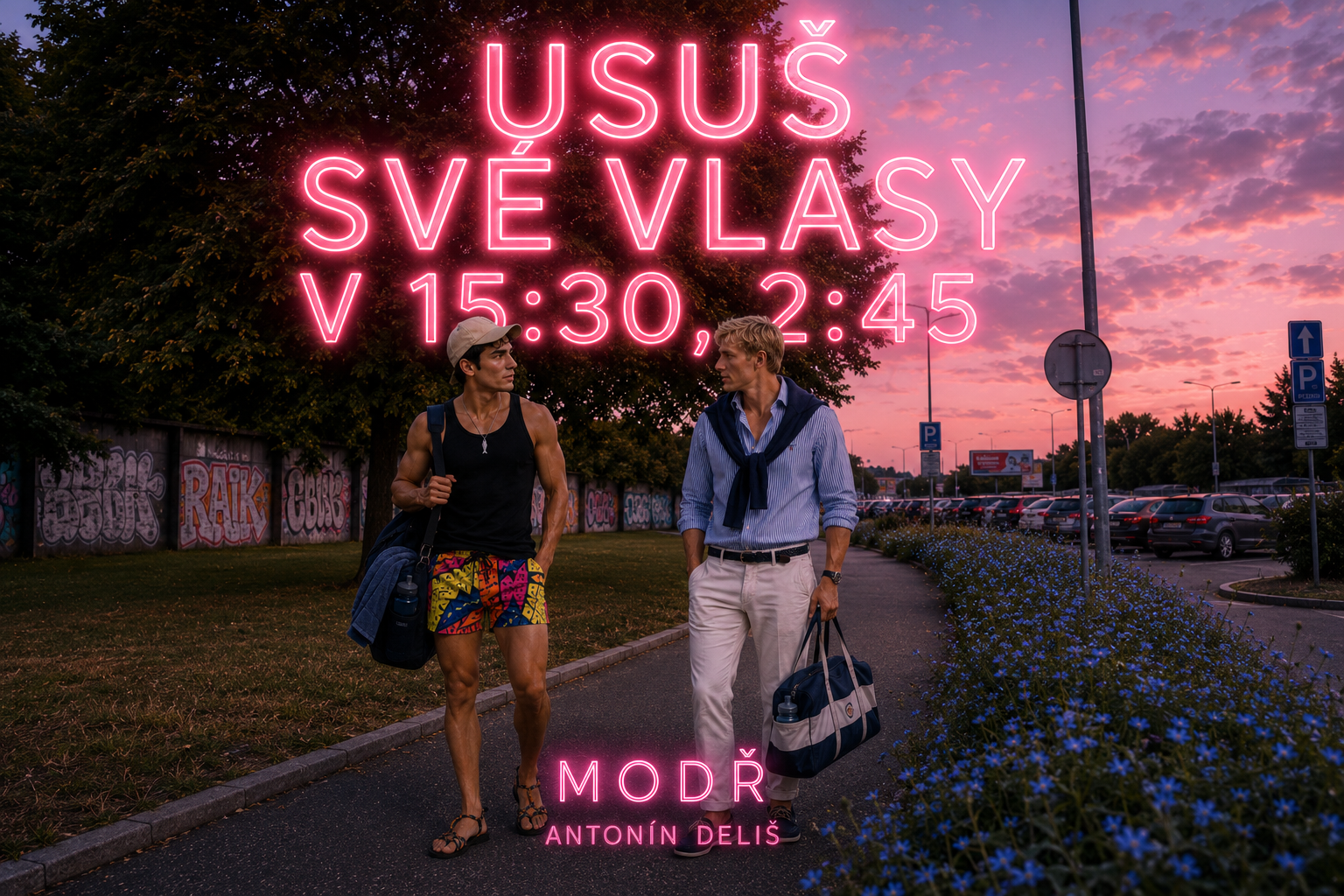
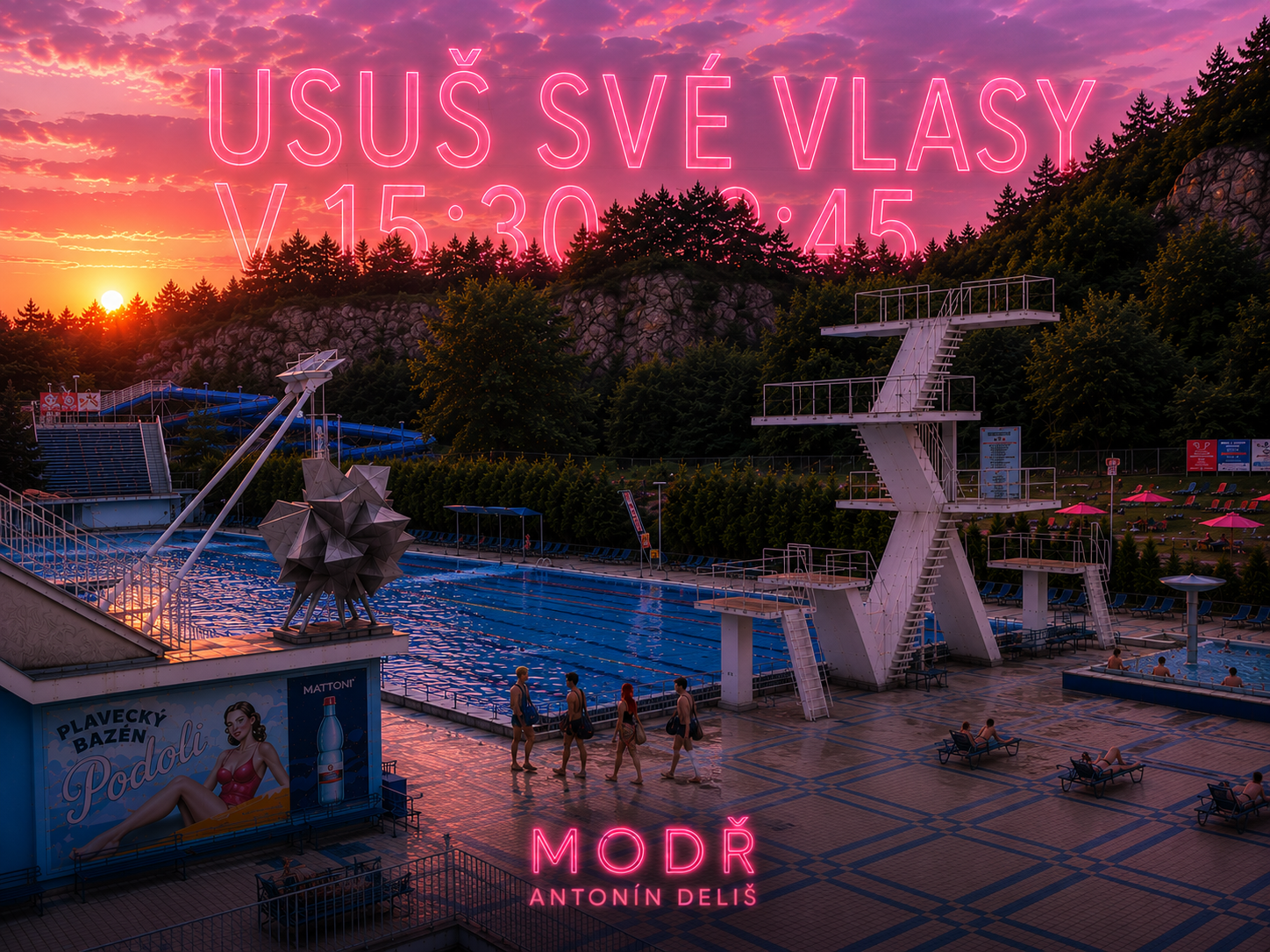
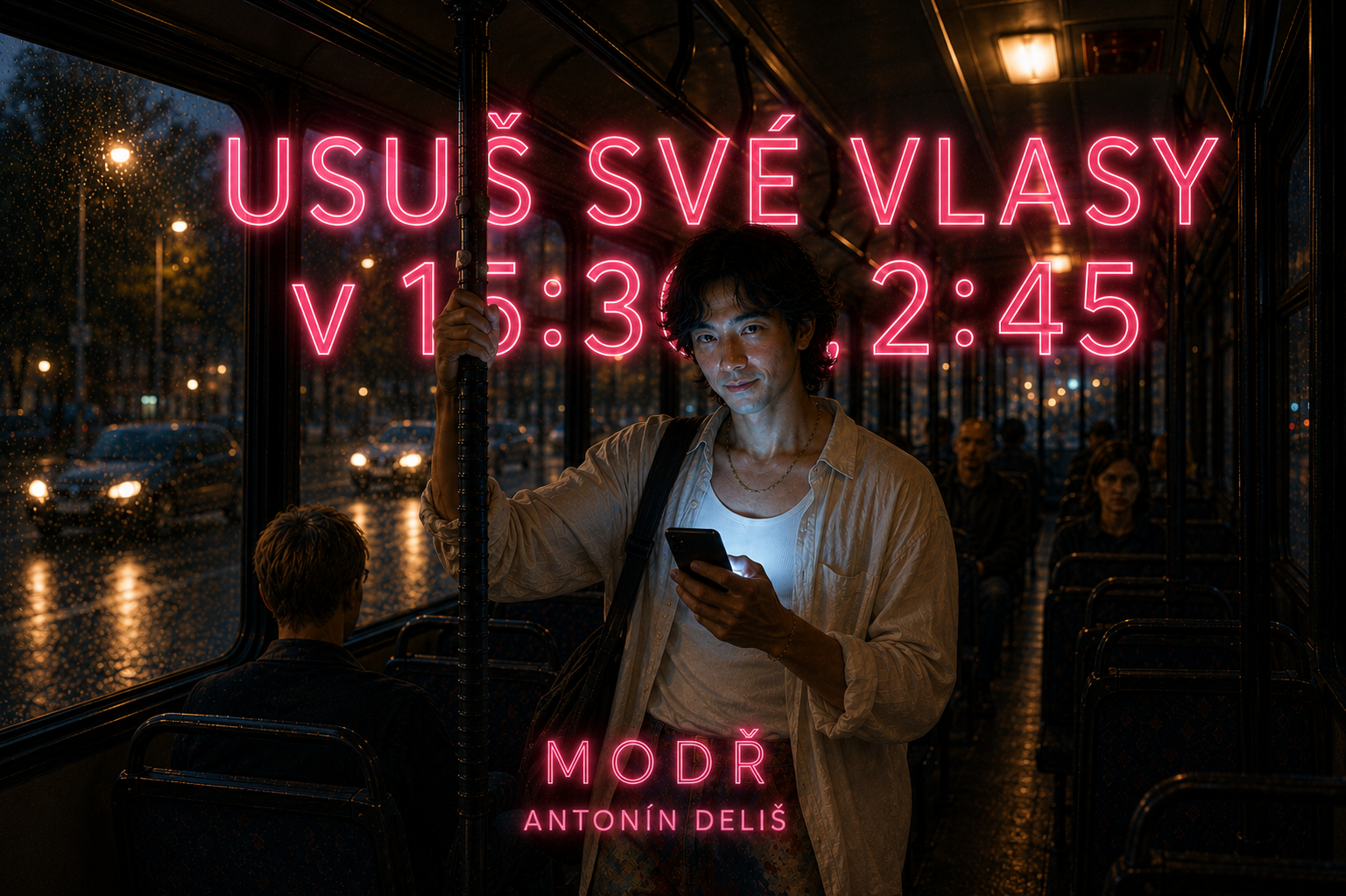
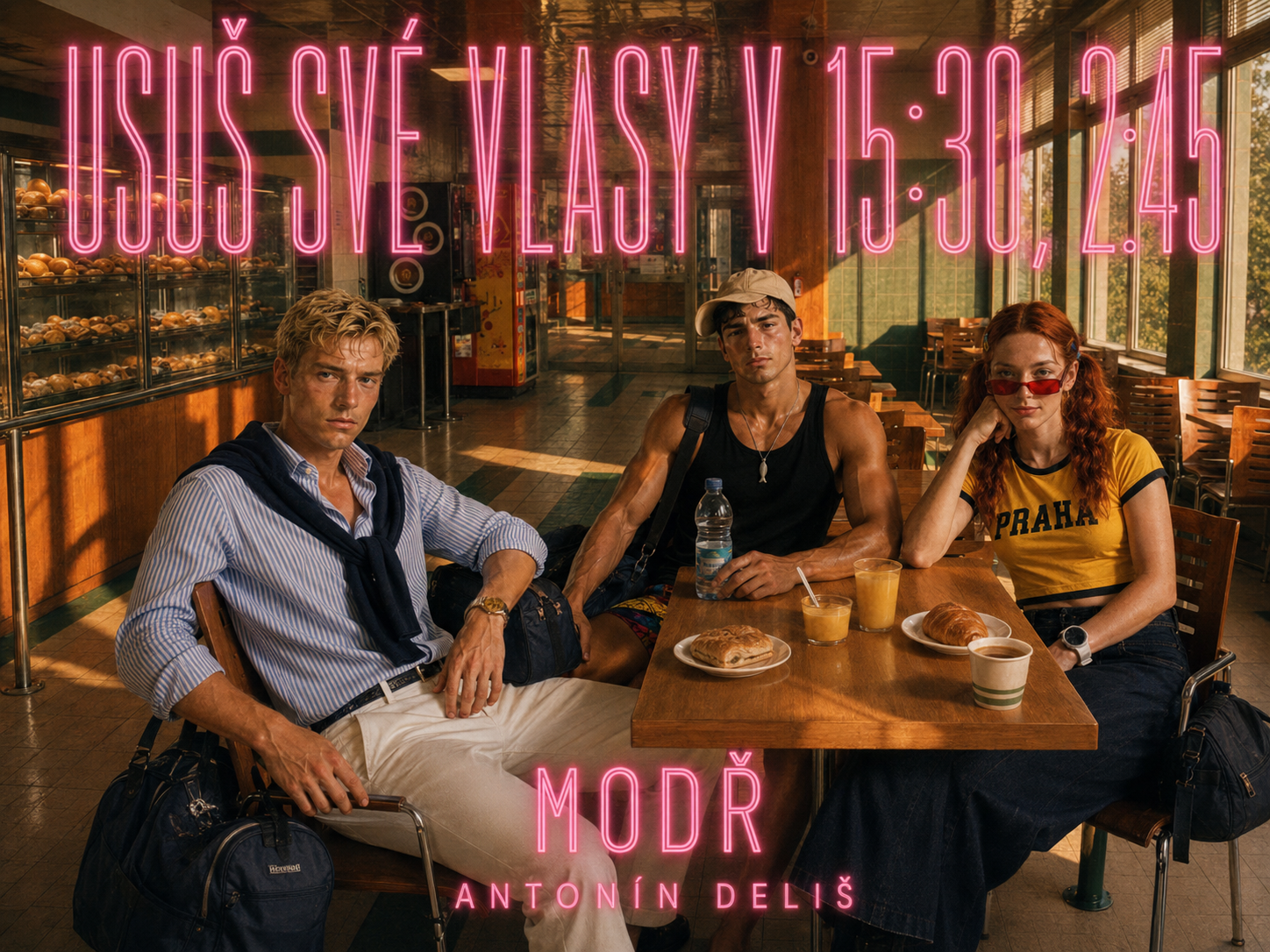
Usuš své vlasy v 15:30, 2:45 — V. díl Modř, oficiální obálka

HEAVY CONTEMPORARY GAY ROMANCE · V. DÍL PENTALOGIE

Modř

Usuš své vlasy v 15:30, 2:45
Antonín Deliš

Závěrečný letní díl pentalogie o návratech, svobodě, blízkosti a vztazích, které nemusí skončit společným životem, aby byly skutečné.

PŘIPRAVUJE SE K VYDÁNÍ

VSTUP DO SVĚTA KNIHY

Vyber si, kudy vstoupíš

Pátý díl pentalogie se připravuje. Objevuj příběh, hudbu a jeho původní vizuály.

Vstoupit do příběhuO KNIZEForendorsČTENÍ · SLEDOVATWattpadČTENÍ · SLEDOVATSpotifySOUNDTRACKVinylHUDEBNÍ VYDÁNÍDatabáze knihKARTA KNIHY
Kniha u partneraPŘIPRAVUJE SE
E-knihaE-KNIHA · PŘIPRAVUJE SE
AudioknihaAUDIOKNIHA · PŘIPRAVUJE SE

OFICIÁLNÍ TRAILER PENTALOGIE

Usuš své vlasy v 15:30, 2:45

Oficiální trailer celého pětidílného příběhu.

Videoklipy a vizuály k Modři ↗

O KNIZE

Na první pohled

ÚVODNÍ POVÍDÁNÍ O KNIZE

Vstup do příběhu

The second summer brings the story back to Prague, Podolí, open-air trams, heated concrete, and the water people return to as if nothing had happened since last year. The stands fill up once again and familiar places look almost the same. Only the characters enter them with a different experience.

Tom still senses Viktor before anyone else does, but he no longer needs to instantly understand his every move. Viktor is able to stay, look at Tom, and not turn closeness into a battle. Between them, there is no simple beginning of a new relationship, but rather memory, trust, attraction, tenderness, and the awareness that neither of them can save the other by giving up their own life.

Veronika also returns to the summer world differently than the first time. Alongside Růženka, she finds space for a closeness that does not rely on performance or responsibility for everyone around her. Modř does not return the characters to their original arrangement. It gives them the opportunity to experience the same places anew and discover that they can remember the past without becoming its captives once again.


SVĚT KNIHY

Pátý pohyb pentalogie

The first part was heat. The second part was constriction. The third part was cold, in which every human warmth became visible. The fourth part was night and a slow return to oneself. The fifth part is space.

Modř concludes the pentalogy with a return to summer, yet it does not return to the beginning. The circle does not close by making everything look the same again. It closes by the characters being able to stand in a familiar place and act differently.

Tom no longer needs to win another person to confirm his own worth. Viktor no longer needs to use flight as the only way to preserve his freedom. Veronika does not have to shoulder all obligations alone, and Růženka is not a denial of the past, but part of the life that continues after it.

The final part does not escalate further pain. It asks what people will do at a moment when disaster no longer presses upon them and they can truly choose. Bodies that in previous parts reacted faster than words do not merely have to defend themselves for the first time. They can swim, lie in the sun, rest, draw close, or let another person go without that departure turning into rejection.

The fifth movement is not a return to lightheartedness. It is a return to life.


HLAVNÍ POSTAVY

Čtyři postavy druhého léta

Tom Záhorský

Tom Záhorský

Tom returns for the second summer transformed, yet still recognizable. He continues to look after Romi, deals with work, money, and everyday responsibilities, and can still react sharply when he feels threatened. The difference is that he is now able to see his own share in relationships and conflicts. Sensitivity ceases to be a crack in a hard surface and becomes a part of his strength.

Viktor Polesný

Viktor Polesný

Viktor no longer has to exist only as a secret in the eyes of others. He gains greater freedom to decide who he wants to be in relation to Tom, his family, the past, and his own name. He does not lose his defiance or his need for movement, but he does not have to use them exclusively to run away. He can walk his own path—and he can return without losing himself in the process.

Tony Leung

Tony Leung

Tony remains an inseparable part of the entire pentalogy's story. His relationships, his way of being close, and his ability to accept others have influenced more people than was apparent at the beginning. In the final installment, it turns out that some characters do not need to be the center of every scene to continue shaping the world around them.

Veronika Coufalová

Veronika Coufalová

Veronika is no longer defined by her relationship with Tom. Their shared past remains part of their lives, but it does not dictate their further direction. Alongside Růženka, she gets to know a more stable form of closeness and gradually accepts that neither help nor happiness has to be a reward for performance or for how much a person can endure.

DALŠÍ POSTAVY PÁTÉHO DÍLU

Další postavy

In the final installment, Romi, Sršeň, Oli, Růženka, and other people who throughout the pentalogy formed the family, sports, and social circle of the main quartet return. Not all of them need a big final gesture. For some, a few precise moments are enough to show where their lives have moved and how their path has touched the others.


SVĚT KNIHY

Místa příběhu

Summer Prague · Podolí · outdoor pools · diving tower and three-meter board · stands, changing rooms and drying room · Vltava River · Braník and Přístaviště · Gorazdova · Vltavská · Karlín · Dlážděnka · kebab · trams and the characters' homes

The final installment returns the story to summer and to the places where the pentalogy began. Podolí lives again with voices, music, wet feet, and scorching concrete. The pool has the same color, the tower stands in the same place, and the paths around the stands lead in the same direction. Only the people returning here are no longer their former selves.

Each part of the stadium carries the previous year within it. First glances, training sessions, jumps, arguments, touches, departures, and moments when someone stayed behind. When Tom, Viktor, Veronika, and the others step into the same space as in the first installment, they are not stepping into the same story. The place remembers who they were. However, it does not have to force them to remain that way.

The rest of Prague works the same way. Braník, Přístaviště, Karlín, Vltavská, Gorazdova, Dlážděnka, or an ordinary tram ride already have their own history. Places that used to mean escape can become a way home. Spaces connected with pain can continue to exist without pain determining every next moment.

Modř does not pretend that one can start completely from scratch. It shows a city where it is possible to continue from the place where one is currently standing.


Originální ilustrace knihy Modř — Místa příběhu

SVĚT KNIHY

V. díl – Co v knize najdete

The final part returns the story to summer Prague and the places where it all began. Podolí, the Vltava river, the scorching concrete, changing rooms, the diving tower, and everyday journeys through the city are no longer the same, however. Along with them, the characters have also transformed as they learn to enter familiar situations differently than before.

Modř concludes the relationship between Tom and Viktor, but devotes just as much space to Veronika, Růženka, and the families who are gradually learning to let their children grow up. Alongside work, school, training, and everyday life, it brings questions of freedom, trust, forgiveness, and the ability to love without the need to possess.

The final volume does not build on a further escalation of pain. It is a novel about the space that arises between people at the moment when they no longer have to save each other. About a return to a life that does not deny the past, but allows one to move on with it.


SVĚT KNIHY

Proč Modř

The title of the final part does not stem solely from the color of the water. Modř permeates the entire concluding part of the pentalogy – it is in the summer sky above Podolí, in the reflections on the surface, in the shadow beneath the diving tower, and in the space that the characters gradually create between themselves.

The first summer was fierce and scorching. The second cannot possibly be like that. Tom, Viktor, Veronika, and the others return to the same places, but they carry with them the experiences of autumn, winter, and spring. They do not forget. They are merely able to look at their own past from a greater distance.

Modř is therefore not the color of forgetfulness nor sadness. It is the color of space. A space in which people can draw closer without possessing each other, and leave without the departure becoming rejection.

At the same time, it concludes the motif of water that permeates the entire pentalogy. In the first part, it was a place of desire, in the second of performance, in the third of fateful moments, and in the fourth of intimacy. In the final part, it opens up again into the landscape, summer, and life that continues onward—above the surface and beneath it.


SVĚT KNIHY

Návrat do léta

The pentalogy begins in summer and also ends in summer. However, this is not a return to the same weather or a mechanical closing of a circle. The first summer finds the characters at a time when their relationships are just beginning to get complicated. The second arrives after a year that has changed their view of themselves, other people, and the places they are returning to.

This time, the summer light does not feel like an escape. Rather, it reveals what remained. Tom already knows the difference between care and control, Viktor knows that running away does not solve every situation, and Veronika is beginning to understand that a relationship cannot be maintained solely by sheer willpower and responsibility.

Summer in Modř remains physical. Skin warms up, clothes stick to the body, the evening light lingers longer, and people move more slowly. Bodies are visible again, but they are no longer merely objects of desire. They carry memory, fatigue, changes, and the capacity to feel joy without guilt.

The final installment does not lead the characters away from ordinary life. They are still dealing with work, school, money, family, and the future. Summer does not offer them a break from reality; it merely gives them a different air and the chance to find out whether they can breathe it differently than a year ago.


SVĚT KNIHY

Podolí jako místo návratu

In the final episode, the characters return to where the whole story began. However, Podolí can no longer be perceived simply as a swimming pool. The diving tower, the stands, the changing rooms, the showers, and the drying room carry layers of encounters, glances, and events that have changed the meaning of every familiar space.

At the same time, Podolí once again becomes an ordinary summer spot. Families arrive, people look for a free spot, fall asleep on blankets, buy drinks, hesitate to jump, or simply watch the water's surface. The world hasn't stopped because of what was crucial for the main characters. For everyone else, it continues at the same rhythm.

It is precisely in this ordinariness that the possibility of return is hidden. The characters can step into the places that left their mark on them and create new memories there. Not to overwrite the old ones, but so that something additional can exist alongside them.

Every morning, the water settles again. Yet what took place within it does not disappear.


SVĚT KNIHY

Gay romance v pátém díle

Modř concludes the story where it once began. In Podolí, among the pools, locker rooms, heated concrete, and summer air that still remembers all the previous years. The places have remained the same. The people passing through them have changed.

Both Tom and Viktor return to the space where they once learned to understand their own bodies, desires, and fears. This time, however, it is no longer about first touches or seeking answers to who they are. Both carry experiences that have transformed them, as well as losses that cannot be erased. Because of this, they are able to perceive the other person differently than at the beginning of the entire pentalogy.

Therefore, the romance in the fifth installment does not rely on dramatic twists or obstacles that must be overcome. It grows out of ordinary moments, shared time, and the awareness that true closeness does not need to be loud to be strong. After years of searching, the most important thing is no longer the desire to win someone over. Much more important is knowing how to stay beside them.

Modř at the same time concludes the journey that the pentalogy has been telling from the beginning. From the first glances through uncertainty, pain, loss, and discovered tenderness, it leads all the way to a form of love that no longer needs to prove anything. Not because all doubts have vanished, but because the relationship between two people does not have to be perfect to be real.

Thus, the final installment is not just the climax of a gay romance. Above all, it is the story of two people who have walked a long path to discover that the greatest transformation did not take place in the world around them, but in how they are able to look at one another—and at themselves.



Originální ilustrace knihy Modř — Gay romance v pátém díle

ZAJÍMAVOSTI ZE SVĚTA KNIHY

Poslední díl se vrací na začátek

MODŘ concludes the pentalogy with a return to summer and to the setting where the whole story began. Podolí, the diving tower, the platforms, the locker rooms, the showers, the steam, the wet swimsuits, the sun-baked surfaces, and the roof once again become part of the characters' lives. However, this is not a return to the same summer. Places may stay the same, but the people returning to them are no longer those who entered them in the first book. The first book was based on the discovery of the body, desire, tension, and boundaries. The fifth installment asks what remains of these experiences after a person goes through consequences, loss, care, and transformation. Therefore, returning to the beginning does not mean going backward. It is an opportunity to see the same place through different eyes for the first time.

ZAJÍMAVOSTI ZE SVĚTA KNIHY

Léto už není žár pod hladinou

The first part carried summer as a season of the heated body, of first sudden decisions and things that could not yet be named. The fifth part returns to summer with a different temperature. It is not colder. It is calmer. Light no longer reveals only bodies, but also the consequences of everything the characters went through. Water does not appear merely as a space of attraction, performance, or escape. It becomes an environment of memory. Every familiar place can remind of what took place there, who was there, and who will no longer return to it in the same way. Summer in BLUES therefore it is not a repetition of the first part. It is its echo.
The same environment creates a different story because the people passing through it have changed.

ZAJÍMAVOSTI ZE SVĚTA KNIHY

Pátý díl už nepotřebuje další eskalaci

The previous parts of the pentalogy gradually increased the pressure. The first installment opened the conflict. The second showed its consequences. The third expanded the world and drove certain relationships to major turning points. The fourth withdrew into sorrow, care, and intimate survival. The fifth part no longer needs to add another great misfortune just to feel like a climax. Its strength lies elsewhere. In what happens when life, after a period of extreme pressure, begins to settle back into an ordinary rhythm. Normality here is not weaker than drama. It can be its most difficult consequence. The characters must learn to live in days when nothing momentous happens, but when it is still necessary to get up, walk somewhere, speak with someone, and decide what one will keep.

ZAJÍMAVOSTI ZE SVĚTA KNIHY

MODŘ není jen barva

Název MODŘ refers to water, the sky, summer, and the colorfulness of the entire series. At the same time, it names a state. Blue can be deep, bright, translucent, and almost black. It can represent a space into which a person gazes without knowing what exactly lies beneath the surface. It is the color of distance, calm, and sadness. In the context of the entire pentalogy, it represents something that cannot be captured in a single meaning. Just like the relationship between Tom and Viktor. Just like summer, which can be both a beginning and an end. The title is intentionally shorter than the previous subtitles. After all the challenges, sentences, warnings, and commands, a single word remains. Space. Color. State.

ZAJÍMAVOSTI ZE SVĚTA KNIHY

Svět se nezměnil, změnily se postavy

One of the main principles of the final installment is a return to familiar places without the need to dramatically transform them. Podolí doesn't need to be destroyed or rebuilt to feel different. The video rental shop, the school, work, family apartments, and other settings from previous books don't need a grand finale. A person can walk through the same gate, walk down the same stairs, or stand by the same pool and still experience a completely different situation. A place gains meaning based on what a person brings into it. Memories. The body. Experiences. Fear. The ability to finally let something go. Therefore, the fifth installment does not base its conclusion on a transformation of the world. It builds it on the transformation of people.

ZAJÍMAVOSTI ZE SVĚTA KNIHY

Tom a Viktor už nejsou na začátku

In the first installment, Tom and Viktor's relationship was built on intensity, attraction, violence, misunderstanding, and a desire that neither knew how to safely bear. In the subsequent books, closeness, resistance, dependency, care, jealousy, guilt, and a shared experience that could not be simply erased developed between them. The fifth installment catches them at a moment when merely reopening the question of whether they want each other is no longer enough. What matters more is what their relationship means for the rest of each of their lives. Love in itself does not have to dictate the only possible direction. A person can deeply love another and still realize that their path cannot continue in the same way. That is not a denial of the relationship. It can be its most honest consequence.

ZAJÍMAVOSTI ZE SVĚTA KNIHY

Nechat druhého jít neznamená přestat milovat

One of the central themes of the final installment is freedom. Not freedom understood as escaping responsibility or as the right to vanish without an explanation. It is the ability not to claim ownership over another person just because something deep arose between two people. Tom and Viktor carry a past together that no one else can fully share. However, this past does not have to lock them forever into a single form of relationship. Letting someone go can mean acknowledging that their life continues in a direction they must choose for themselves. It can hurt. It can feel like a loss. At the same time, there can be more love in that than in an attempt to keep a person by your side at all costs.

ZAJÍMAVOSTI ZE SVĚTA KNIHY

Jemnost přichází až po všem ostatním

Tenderness was present in the pentalogy from the beginning, but for a long time it appeared among fiercer forces. Desire. Violence. Performance. Jealousy. Shame. Fear. Loss. In the fifth installment, tenderness no longer has to fight for its place in the same way. It can manifest in an ordinary glance, in a movement beside another person, in a moment when no one is forcing anything, or in the decision not to speak a sentence that would shackle the other person once more. This is not about a sudden transformation of the characters into calm and flawless people. Tenderness here is the result of experience. The characters do not possess it automatically. They must learn it. Adulthood is not a victory. The fifth installment captures the characters at a point where they are further along than at the beginning, but they are not finished. Adulthood in this series does not mean that a person stops making mistakes, understands all their emotions, and starts making the right decisions. It means rather the ability to bear that some decisions do not have clean resolutions. A person can do the right thing and still hurt someone. They can let someone go and later have doubts. They can return to a familiar place and find that they no longer find what they were looking for there. Adulthood is not a point where life is solved. It is the willingness to take responsibility for one's own movement.

ZAJÍMAVOSTI ZE SVĚTA KNIHY

Veronika a Růženka představují jiný druh pokračování

The relationship between Veronika and Růženka in the final installment does not feel like a dramatic counterpart to Tom and Viktor. It represents a different possibility. A relationship does not have to be any less deep just because it doesn't play out through constant plot twists, struggles, and extreme situations. Stability does not mean an absence of life. It can be the result of work, decision-making, and the willingness to create a space where the other person doesn't constantly have to prove they have the right to stay. Veronika gradually detaches herself from the role of someone who merely fixes the consequences of other people's behavior. Her story can begin to focus on her own closeness, her own needs, and a life that isn't just an appendix to Tom. In this regard, Růženka does not arrive as a reward. She is part of the journey toward a different way of relating.

ZAJÍMAVOSTI ZE SVĚTA KNIHY

Vedlejší postavy nemusí dostat velké finále

The pentalogy has a broad ensemble. Therefore, not every character needs a final scene explaining precisely what happened to them and where their life continued. Some people enter our lives only for a certain period of time. They leave a mark, change the course of events, and then drift away. That doesn't mean they were unimportant. The fifth installment respects this natural passing of people. Some fates are concluded more clearly. Others remain open. The reader does not need a complete overview of every future to understand a character's significance to the overall story. The lives of the secondary characters continue even outside the slice of life captured by the book.

ZAJÍMAVOSTI ZE SVĚTA KNIHY

Paměť není totéž co minulost

In the final book, the characters return to the events of the previous ones. However, this is not merely a summary of the plot. Memory does not preserve the past accurately. It magnifies certain moments. It suppresses others. It connects events that were originally unrelated and changes their meaning based on what a person has experienced since.
Therefore, Tom and Viktor cannot look back at the beginning of the pentalogy in the same way they experienced it at the time. What felt like attraction in the first installment may, years later, also feel like a warning. What once seemed like a conflict may turn out to have been a first, clumsy attempt at contact. Memory excuses nothing. Yet it allows one to see their own past in a broader context.

ZAJÍMAVOSTI ZE SVĚTA KNIHY

Návrat do Podolí není nostalgie

Podolí is the central location for the entire series. In the fifth installment, however, the return to the pool must not become merely a nostalgic reminder of favorite scenes. The space returns to show the difference between then and now. In the first installment, Podolí was a place where the characters discovered themselves and each other through the body. In the final installment, they already know that the body carries memory. It carries touches, impacts, training, fatigue, illness, desire, and loss. The diving tower may still stand in the same place. Yet it no longer represents the same challenge. A person does not have to jump again to prove they have changed. Sometimes the change is precisely the ability to stand still, look, and decide differently.

ZAJÍMAVOSTI ZE SVĚTA KNIHY

Střecha otevírá jiný pohled

The roof in summer Podolí broadens the perspective. The characters are not just under the surface, in the locker room, or right next to each other. They can look at the space from above and for a moment see it as a whole. This view is connected to the final installment. After four books, the story no longer needs to remain solely within the immediate feeling. It can look back. Not to explain everything, but so that the characters and the reader can see the distance they have traveled. At the same time, the view from above does not mean complete control. A person can see the pool, the paths, and the city and still not know what exactly awaits them after the descent. Detachment is not certainty.
It is simply the opportunity to see more than before.

ZAJÍMAVOSTI ZE SVĚTA KNIHY

Tělo už není bojištěm stejným způsobem

From the first installment, the body has been one of the main themes of the series. It has been a source of desire, shame, performance, violence, illness, care, and spiritual experience. In the fifth installment, it does not have to stop being a site of conflict. However, the characters' relationship to it changes. The body no longer has to constantly prove its strength, attractiveness, or endurance. It can simply be present. It can swim, rest, stand next to another body, or move without the need to turn every touch into a decisive event. This ordinariness is not a retreat from the corporeality of the series. It is its fulfillment. The body does not have to constantly be drama in order to be important.

ZAJÍMAVOSTI ZE SVĚTA KNIHY

Sexualita není na konci vyřešená poučka

From the beginning, the pentalogy deals with sexuality without trying to reduce it to a simple moral or identity message. The characters may label themselves differently, they may not label themselves at all, and their desire may not always match the expectations of those around them or their own plans. The fifth installment does not erase this complexity.
It does not create a concluding moral about what each character truly is and whom they ought to love. Sexuality remains part of the whole person. It is connected to the body, experience, relationship, safety, solitude, desire, and the moment. Therefore, the end of the story does not lie in the definitive classification of the characters.
It lies in their greater ability to accept their own movement without the need to lie to themselves or others.

ZAJÍMAVOSTI ZE SVĚTA KNIHY

Svoboda není samota

A parting of ways does not have to mean that a person remains alone. Freedom in BLUES is not a celebration of isolation. It does not say that the most mature person needs no one. It shows the possibility of being in a relationship without the other person becoming the sole reason for one's own existence. Both Tom and Viktor must learn to distinguish between closeness and attachment. Between a shared past and the obligation to have a shared future. Between care and control. A free relationship does not have to be less emotional. On the contrary, it can be truer because it allows both people to remain complete personalities.

Originální ilustrace knihy Modř — Svoboda není samota

ZAJÍMAVOSTI ZE SVĚTA KNIHY

Obyčejný život je skutečné pokračování

After everything the characters have experienced, ordinariness can feel almost inappropriate. Food. A journey through the city. A warm day. Waiting. A conversation without a grand revelation. An encounter that does not end in conflict. Yet it is precisely these moments that show whether life has truly moved forward. A major event can change a person in a matter of minutes. But true transformation is tested in the days that follow. In how a person reacts when they are no longer under immediate pressure. Whether they resort to old behavioral patterns again. Whether they manage to say something sooner. Whether they recognize the moment when they should stay and the moment when they should leave. The conclusion is not meant to deny the previous parts. The final part cannot turn past pain into a mere obstacle on the path to a happy ending. What happened remains part of the characters. Some losses cannot be undone. Some relationships cannot be returned to their original form. Some actions cannot be erased by later understanding.
However, the conclusion also does not need to claim that a person has been permanently condemned by their past. Between forgetting and eternal punishment, there is a space. A person can carry their past and still move forward. They can remember without repeating. They can accept responsibility without surrendering their right to a future.

ZAJÍMAVOSTI ZE SVĚTA KNIHY

Návrat k létu uzavírá kruh, ne klec

The pentalogy begins with summer, continues with autumn, winter, and spring, and returns to summer in the final installment. This structure creates a circle. However, a circle does not necessarily mean that the characters end up in the same place. The seasons repeat, but no summer is identical to the previous one. A person may stand by the same water, but carries a different body, a different memory, and different possibilities. Therefore, the return is not an entrapment in infinite repetition. It is proof that time continues in cycles, while a person can transform. A circle is not a cage. It is an opportunity to walk through a familiar place once again and choose a different direction this time.

ZAJÍMAVOSTI ZE SVĚTA KNIHY

Poslední díl nemá všechno dovysvětlit

MODŘ it concludes the pentalogy, but it does not have to answer every question. Some things are meant to remain alive even after the last page. The future of the characters is not a spreadsheet that needs to be completely filled out. What matters is whether the ending captures the direction they are capable of continuing in. The reader should know enough to understand their decisions. However, they do not need to be given certainty about every subsequent year of life. Openness of the ending does not mean unfinishedness. It can respect the fact that human life continues beyond the boundary of every story.

ZAJÍMAVOSTI ZE SVĚTA KNIHY

MODŘ je konec jedné podoby vztahu

The final installment is not just the end of five books. It is the end of a certain form of relationship between Tom and Viktor. A form based on the fact that they return to each other through intensity, pain, and the inability to fully detach. What was between them is not erased. It does not have to diminish or lose its value.
However, it can transform. The end of one form of relationship is not always the end of love. Sometimes it is the moment when love stops demanding the only possible outcome.

ZAJÍMAVOSTI ZE SVĚTA KNIHY

Pentalogie končí pohybem

The entire series worked with body movement. Entering the water. Swimming. Climbing the tower. Turning around. Jumping. Falling. Returning. Staying until morning. In the final installment, it is no longer about the highest jump or the most dramatic impact. Direction is what matters. The characters do not have to move together for their shared journey to lose its meaning. Each of them must take away what they have learned about the body, love, violence, care, freedom, and responsibility. MODŘ therefore does not end with the claim that everything turned out fine. It ends with the possibility that life can continue more truthfully than before. Not without pain. Not without memory. But also not beneath the surface forever.


PRO ZARYTÉ FANOUŠKY PÁTÉHO DÍLU

Ještě zůstat ve světě

Soundtrack, obrazy, rozhovory a další skutečné materiály ke knize.

Modř concludes the story that began in the first part by the water, in the drying room, in the showers, and around the diving tower. Readers of the previous parts will return to familiar places and to characters whose relationships have fundamentally changed over the course of the year. The final installment works with the return of motifs from throughout the series. However, water no longer holds the same meaning as it did at the beginning. The look between Tom and Viktor is not the same. Nor is the silence between them the same. In the first part, they did not know what they meant to one another. In the last, they know all too well. The book also returns to the small, everyday motifs that accompanied the pentalogy from the beginning. To tram rides. To changing clothes. To wet hair. To caring for others. To food carried home. To glances caught in a mirror or over a shoulder. To physical closeness that can be both natural and unbearably significant. Some images will intentionally resemble the first part. However, this is not a matter of copying them. The same movement can mean something entirely different after a year. The same place can simultaneously be a memory and the beginning of a new situation. And the same person can stand before Tom without Tom seeing only his own desire in them. Readers who have followed the entire story from the first part will also witness the transformation of secondary characters. Not all of them will receive a definitive ending. However, they will be given a trace of life that goes on.


AUTORSKÝ A VYDAVATELSKÝ CYKLUS

Jak vznikají a vycházejí moje knihy

My books are not published in all formats at once. Each goes through a gradual authorial and publishing cycle.

  1. I write the book.
    The text, characters, world, atmosphere, and the entire authorial context are formed.
  2. At the same time, I compose music.
    Songs, motifs, moods, and a soundtrack are created for the book.
  3. I release the music.
    First on SoundCloud, then on Spotify, Apple Music, Amazon Music, and other platforms.
  4. I release physical music.
    Selected projects are followed by vinyl.
  5. The book goes to Forendors.
    It appears there in advance as part of supporting my work.
  6. The book goes to the Endralon Space website.
    It gets its own page, information, excerpts, links, and context.
  7. The book goes to Wattpad.
    I publish it there gradually, chapter by chapter.
  8. The printed book follows with partners or via the printing platform.
    This is a publicly available edition of the book.
  9. After that, I am preparing an e-book.
    First PDF, then EPUB. It is not just saving a file, but typesetting, checking, and preparing a readable version.
  10. The audiobook follows.
    That comes only after the text and book part of the cycle.
  11. Finally, signed author copies arrive.
    I have the books printed, sign them, and send them to readers personally.

What this means for readers

When a PDF, EPUB, audiobook, or signed copy is not yet available for a book, it is not an error or a forgotten item. It means the book is currently in a certain stage of publication. I add formats gradually, without a fixed time promise, as the entire authorial cycle naturally reaches its completion.


PŘIPRAVUJE SE K VYDÁNÍ
Dostupnost

Dry Your Hair at 15:30, 2:45 – Part V: Modř coming soon.

The book will be available separately and at the same time as the final part of the entire pentalogy.

Current information on the publication, formats of the book and ordering options will be gradually published on this website and on my social media.

The first and second parts are already available.

The third, fourth and fifth parts are in preparation.


TECHNICKÉ ÚDAJE

Title
Dry Your Hair at 15:30, 2:45 – Part V: Modř
Author
Antonín Deliš
Genre
gay romance / heavy contemporary
Language
Czech
Setting
Prague, Podolí, Braník and other locations associated with the previous parts
Time period
summer
Position in the series
fifth and final installment of the pentalogy
Planned scope
approximately 350 pages
Status
forthcoming

SOUVISEJÍCÍ KNIHY

Pokud jste četli předchozí díly

Explore other installments

VŠECH PĚT DÍLŮ

Celá pentalogie Usuš své vlasy v 15:30, 2:45

Part I – Žár pod hladinou
Part II – O-TOČ-SE | NEŽ-SKO-ČÍŠ
Part III – Trestný čin něhy
Part IV – Přežili jsme tu noc
Part V – Modř


Sdílet článek

Další možnosti sdílení

Další aplikace najdete v nabídce „Sdílet do aplikace“, pokud je podporuje vaše zařízení. Odkaz můžete také vložit do libovolné sítě nebo zprávy.

SOUČÁST SVĚTA ENDRALONU

Součást světa Endralonu

Modř is part of the literary world of Endralon. A world where intimate stories are inseparable from social reality, money, work, family ties, corporeality, and the places where characters actually live. The pentalogy combines gay romance with heavy contemporary prose. It does not depict relationships as isolated love stories. It shows them within families, households, sports teams, work environments, and the city, which affords the characters both anonymity and the constant proximity of others. In Modř this world does not expand to include new major settings. Instead, it focuses on places the reader already knows. Thus, the conclusion is not created by adding another world. It arises from a fresh perspective on the original one.


PUBLISHED · NEW TITLES

Open worlds

All books ↗

IN PREPARATION · 2026

What is happening now

Books in progress, newly finished texts and everything currently moving forward in the world of Endralon.

Open updates ↗

SEARCH THE SITE

VISITOR ARCHIVE

Who has passed through this world?

Today—

Traces of people among books, soundtracks and night cities.

TOTAL
12 937
THIS MONTH
—
Yesterday
—
Visitor measurement is temporarily paused.