
When I was thinking before this year's Book World about which book I would take there, my mind was made up.
I thought I would focus most of my attention on the series Dry your hair at 15:30, 2:45.
It is a project to which I dedicate a huge amount of energy. I live with its characters, I know their future, I know their falls and their loves. It seemed natural to me that this very book would be at the center of my attention.
But then I had a strange dream.
I saw a funeral procession.
Among the people, I caught a glimpse of a figure that I later actually went looking for at Book World. The procession continued all the way to the seashore. And there, something strange happened.
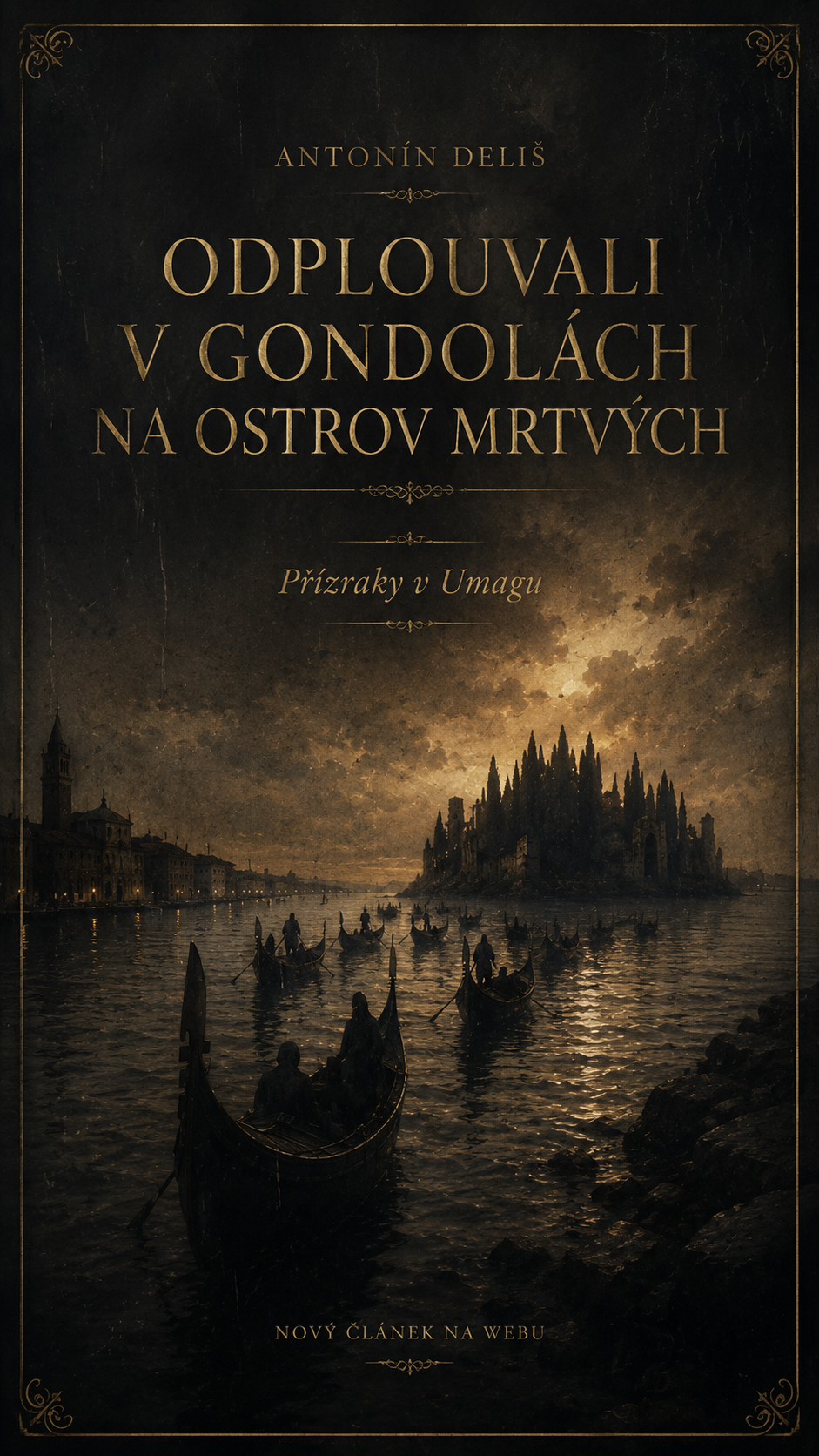
Everyone got into the gondolas.
Not ships.
Not boats.
Gondolas.
And they were sailing away to the island of the dead.
When I woke up, I knew that to Svět knihy I shouldn't go with Dry your hair at 15:30, 2:45 as the main book.
I should go with Přízraky v Umagu.
I couldn't explain it reasonably.
I just knew.
A Sunday at the fair, which was supposed to be joyful, suddenly fell silent. Some people stepped aside. Tears appeared. Suddenly everything was different. My aunt Slávinka died.
And later I realized something strange.
The motif of death and departure was present in Přízraky v Umagu from the very beginning.
Recently, after years, I opened the old notebooks in which the novel was created. Among the notes I found pages on which I was counting down the days until the Death Statute.
Quite ordinarily.
Six days before death.
Five days before death.
Four days before death.
As if back then I were creating my own calendar of inevitability.
And yet I never wanted to write a novel about death.
At least I thought so.
When I read my old notes today, I see that I kept returning to finiteness constantly. Not just in this book. Throughout the entire trilogy Poslední noc v New Yorku people vanish, leave, lose each other. Some die. Some simply walk out of the lives of others.
And perhaps that is precisely why it surprised me so much when I realized that one of the most-played tracks of the soundtrack on SoundCloud is in fact Pavel’s Death.
A song about the moment when a person learns that someone they loved is no longer here.
In reality, however, it was never a song about Pavel.
It is a song about Stano.
About the few days during which the light gradually goes out inside him.
About the moment when he understands that some losses can no longer be undone.
And perhaps also about the moment when a person first glimpses their own finiteness.
When I think about the gondolas from my dream today, Böcklin's Island of the Dead.
comes to mind.
Not literally.
More like a feeling.
Like a quiet awareness that every life is also a journey toward departure.
That one day we will all step into our gondola.
And that some stories know this before their authors do.
Perhaps that is why I write.
Not to save people.
Not to prove anything to anyone.
And least of all to take revenge on anyone.
I write out of love.
The people who appear in my books have left a mark on me. Some of them know it. Others do not. Some have long since gone elsewhere. Some have disappeared from my life entirely.
But they remain in the stories.
Not in their true form.
Transformed.
Dispersed among characters.
Spread across sentences.
Hidden between pages.
And perhaps that is precisely why the image of gondolas heading toward the island of the dead struck me so deeply.
Because I realized that Přízraky v Umagu they are not a book about death.
They are a book about what we try to preserve when we know that everything will one day disappear.
And perhaps it is the same thing in the end.















