ENDRALON.SPACE · ČLÁNEK
9. 8. 2026
BÝLÍ (poetry collection)
ENTER THE WORLD OF THE BOOK FORENDORS → WATTPAD → READ HERE → SPOTIFY → VINYL → AUDIOBOOK BOOK AT PARTNERS → RATE THE BOOK ON DATABÁZE KNIH → BÝLÍ is a poetry collection about the light that arrives too late. About a person who left, but did not die. About a love that ended before it could grow old, yet carried a whole life within itself. And about the time after it [...]
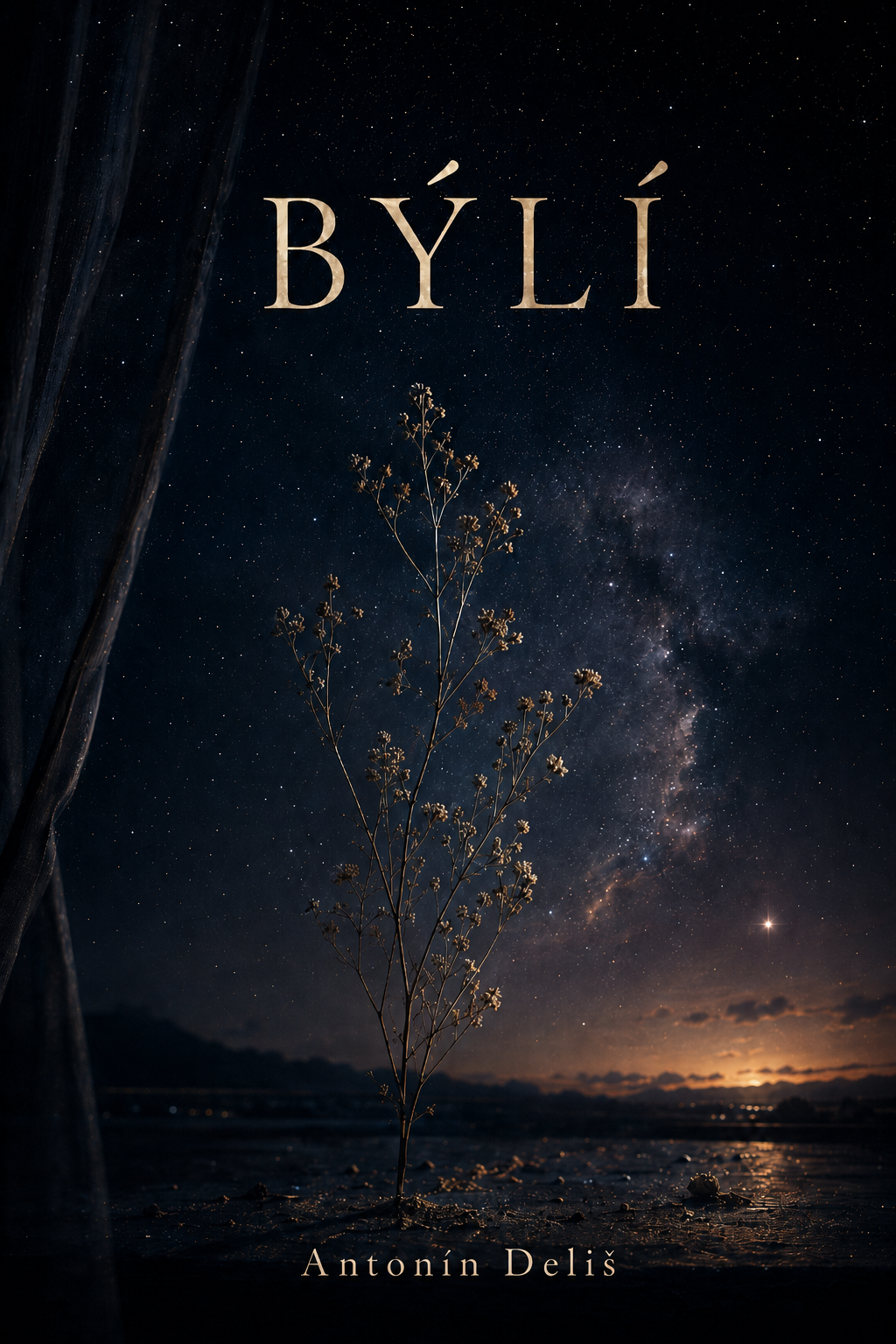
BÝLÍ is a poetry collection about the light that arrives too late. About a person who left, but did not die. About a love that ended before it could grow old, yet carried a whole life within itself. And about the time after it — a time that first refuses to move and then begins to open up into places whose light has not yet reached us.
The collection connects intimate experience with the universe, the relativity of time, gravity, black holes, light cones, gravitational lenses, parallel possibilities of life, and distances that cannot be measured in kilometers alone. Cosmic phenomena are not mere decoration here. They become a language for things that are difficult to explain in ordinary words: absence, fading, memory, gratitude, desire, solitude, and the courage to go on.
And amidst it all stands ordinary weeds in a vase.
Enter the collection
My eyes knew before I did.
It is with this exact sentence that BÝLÍ begins. The body has already accepted something that consciousness has not yet been able to name. Tears come before a decision, pain before a sentence, an end before the moment it is truly spoken. From there, the collection gradually moves away from a single room, a single door, and a few photographs toward questions that no longer have a human scale. How far away can a person be whose light is still reaching us? How much life can fit into a few months? Can something end without ceasing to be real? And if all the light we see in the sky today comes from the past — what does the future actually look like?
BÝLÍ as the reverse side of ČERNÝ
BÝLÍ is created in dialogue with the collection BLACK, but it is not its simple opposite. The title does not mean "white". Weeds are wild plants, dry stems, tiny flowers, something unassuming that can stand in a vase long after it has ceased to be a living flower. This conceals one of the central images of the collection: something is no longer growing, and yet it has not disappeared. In the evening light, a dry stalk can cast a shadow on the wall resembling a constellation. What has ended can still create an image. WEEDS is therefore not a path from black to white. It is a book about the moment a person discovers that between darkness and light there is a much greater space.
What you will find in the collection
The collection consists of a prologue, fifteen poems and an epilogue. Its first part returns to memory, childhood, photographs, a room, absence and a brief relationship that in subjective time grew far beyond its calendar length. Gradually, however, the poetry leaves behind the purely earthly scale. Into the text enter delayed starlight, the expansion of the universe, time dilation, gravitational fields, wormholes, parallel possibilities of life, the relativity of the present, the light cone and the gravitational lens. The final part is no longer primarily about the person who left. It is about time without him. About returning to one's own apartment. About old lives that reappear for a moment. About a future that may not be closed—just that its light hasn't arrived yet. And finally, about moving into a space for which maps do not yet exist.
Why WEEDS
Weeds stand in a vase and the lyrical speaker keeps calling them flowers. This very contradiction carries a large part of the book. Is something less real just because it couldn't be publicly named? Is love smaller because it didn't last for years? Does something stop being alive the moment it ends? And to whom do flowers that were never handed over belong? Weeds are simultaneously a remnant and proof of existence. They are dry, but still create a shape. They are dead, yet they react to light. They are ordinary, but in the dark they can resemble a star cluster. The title thus connects the smallest material object of the book with its largest space—the universe.
The universe is not a backdrop
In WEEDS, stars are not a way to make pain more beautiful. The universe offers a different logic. We never see a star as it is right now. We see the light that left it minutes, years, or millions of years ago. It may have ceased to exist long ago and yet still shine upon us. This very fact becomes one of the fundamental principles of the collection. A person, too, can long be seen after their departure in the form they emitted earlier: in a room, a song, a photograph, a hand movement, the way they pronounced a name. WEEDS therefore does not merely ask whether something has ended. It asks, when its end actually reaches us.
Time that does not have the same length for everyone
According to the calendar, a few months may be short. But subjective time does not abide by the calendar. It is precisely for this reason that the collection features the motif of relativistic time known also from the film Interstellar: near extreme gravity, two observers can experience dramatically different lengths of time. This physical principle in BÝLÍ does not pretend that a romantic relationship was literally a relativistic experiment. Instead, it offers a more precise question:
Why can entire years with one person fit into a few sentences, while a single night with them still has no end? A calendar measures length. It does not measure its weight.
Two absences
One of the recurring images in the collection is two photographs. One absence has a grave. The other an address. One star has gone out. The other continues to shine in a constellation to which the lyrical speaker does not belong. Here, BÝLÍ places two different kinds of loss side by side — death and departure — without confusing them. Yet at night, a room may not know the difference. Neither photograph turns around when one speaks a name. The collection thus also touches upon a peculiar kind of mourning for someone who still exists.
Paper star
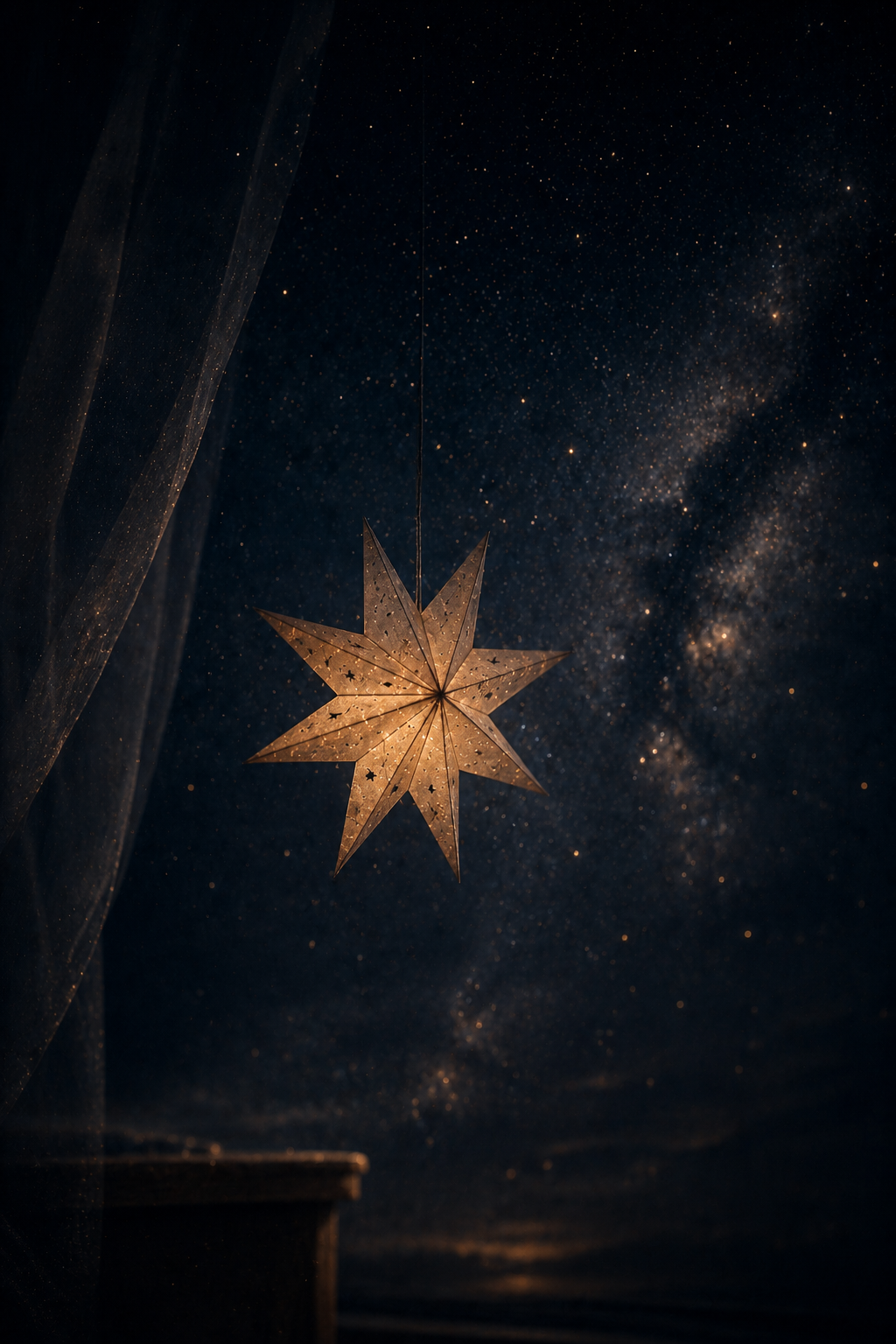
The universe of the collection does not begin with a telescope. It begins with paper. A father folds a sheet of heavy paper, hands a child small scissors, and teaches them to cut out hearts, stars, and small things meant for someone they love. This childhood motif later returns on an entirely different scale. A paper star, a real star, and a person can simultaneously be a presence, a memory, and the light passing through a cut-out space. The fatherly motif also returns at the close of the book: two distant edges of paper can be brought together to create a place that did not exist before. Not a return. Direction.
WEED and Interstellar
Interstellar are important visual and conceptual sources for the collection, though not as a world that WEED would rewrite. The experience of scale is essential. A person can stand in a room and at the same time contemplate light traveling for thousands of years. An hour can have a completely different duration in another place. A gravitational field can bend light so that a single source is seen multiple times. Beyond the event horizon, intuitive notions of direction, time, and return cease to function. In WEED, these phenomena share one common function: to shatter the certainty that life must function according to the rules we have known until now.
Curiosities from the world of the collection
Everything we see has already happened
One of the most important ideas in the book is a simple astronomical fact: we see no distant object in the present. Light takes time. We see the Sun approximately eight minutes in the past. Distant stars years or centuries earlier. Galaxies may be images of a universe millions or billions of years old. WEED turns this fact into a personal question: if everything visible is the past, what are we to navigate by toward the future? For the future has not yet sent out any light.
Old planets return
In one of the poems, the past does not return as nostalgia, but as possible lives. Old contacts and ancient possibilities momentarily penetrate the present like signals from parallel branches of reality. It is neither about evaluating them nor about making decisions between people. What is essential is the change of the observer. The same city may remain in the same place. Yet a person no longer has to be at the same coordinates.
No one like you will ever come again
This sentence is not a tragic verdict in BÝLÍ. Quite the opposite. A gravitational lens can bend the light of a distant object, multiply it, and create multiple images of a single source. But an image is never the source itself. Similarly, the future does not have to bring a copy of someone who left. It can bring something completely different. And it is precisely the acceptance of this dissimilarity that opens a space where the new no longer has to compete with the past.
Body without a verdict
One of the less conspicuous but essential movements of the book is the changing relationship to the body. It is neither about finding a "more beautiful" body nor about a new ideal. On the contrary: the experience of acceptance gradually relieves the body of the need to prove its own value. Skin, scars, belly, aging, or shape cease to be a judgment. The body becomes a place through which light merely passes. What is important begins to lie deeper than on the surface.
The room turns into a cosmos
WEEDS moves between two scales. One is the universe. The other is a room. The street door, the stairs to the apartment, the lock, the sofa made from a bed, photographs on a table, a vase, a lamp, or a spider's web are not opposites of cosmic motifs. They are their human scale. After leaving, the room rearranges itself. Things change their trajectories. The apartment stops orbiting around an absence. And in the corner behind the sofa, meanwhile, a spider manages to spin a web. Life does not ask whether it is time yet.
The future is not yet visible
The final poems of the collection change direction. The past is no longer the only gravitational force. The relativity of the present emerges, the light cone, future places and events that may be real even though they do not yet lie within the reach of current light. A person does not need to know immediately where they are heading. Perhaps not all doors are closed after all. Perhaps their light simply hasn't arrived yet.
Epilogue: from where no light has come yet
The epilogue returns to several images from the beginning of the book: the father, the paper, the star, and the weeds. Only their meaning has changed. The stars in the sky belong to the past. The future cannot be followed according to familiar constellations. Therefore, the path forward does not lead toward the light, but paradoxically from where no light has come yet. In the evening, the lyrical speaker lays his head on a pillow with a star. This time the star is truly present. It is not flying toward him through the past. It is beneath his face. Right now. And in the fold of the fabric between the star and the night, a tiny weed flower remains.
How WEEDS is created
BÝLÍ is not a poetic diary in the chronological sense. Real events are the bedrock, but the poems do not retell them. A specific moment can transform into a cosmic phenomenon. A glance into a glass door into a question of delayed light. An encounter on opposing escalators into the passing of two possible realities. A relationship lasting several months into a problem of relative time. Therefore, while working on the collection, a set of personal rules emerged: a cosmic metaphor must have a real foundation, must not obscure the experience, and a physical phenomenon must respect at least its basic logic. The universe is not used to make an ordinary thing seem more important. It is used because some ordinary things are too big for the language of a single room.
The Visual World of BÝLÍ
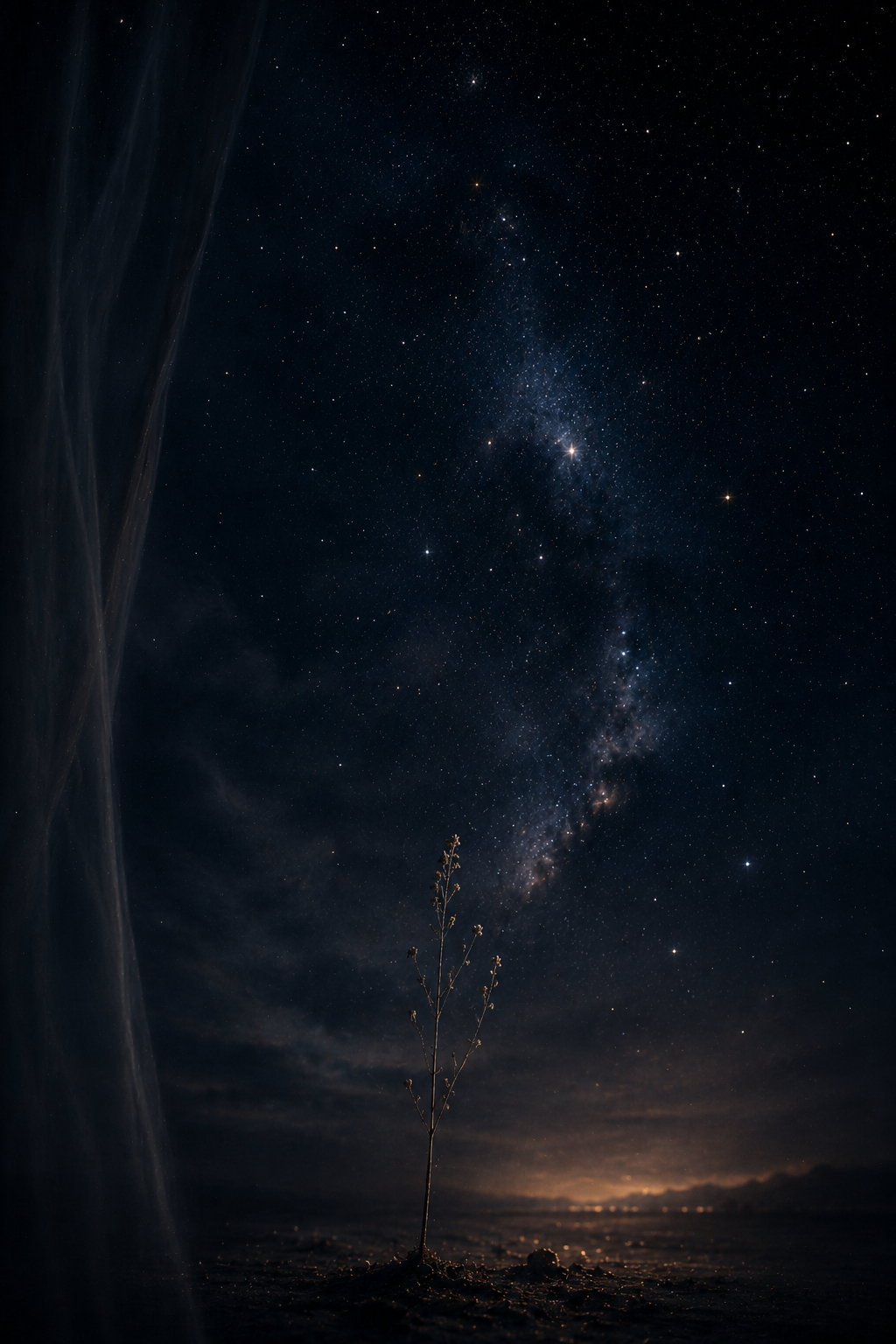
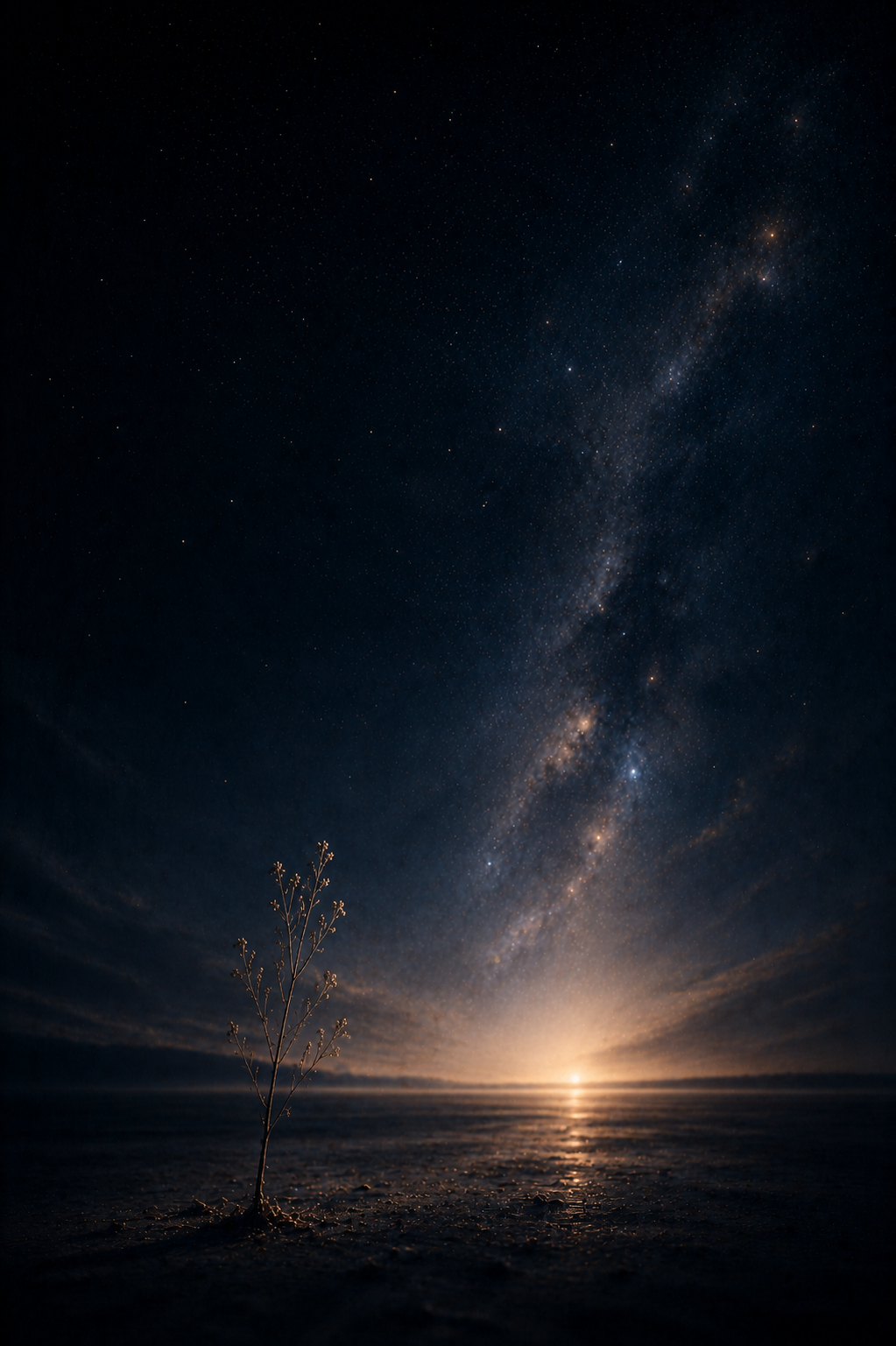
The visual identity of the book consists of a deep blue-black night, delicate star fields, nebulae, golden light, and dry weeds. The central cover places a tiny plant against an incomparably larger cosmic space. It is precisely this contrast that corresponds to the principle of the entire collection: the most intimate human experience can take place in the same world as galaxies, gravitational fields, and light traveling for billions of years. Therefore, the internal visuals are not meant to literally illustrate individual poems. They are meant to function as quiet waystations between text, darkness, and light.
Part of the Endralon universe
BÝLÍ belongs to the broader authorial work of Antonín Deliš, in which literature connects with image, music, and other layers of storytelling. At the same time, it forms a pair with the collection BLACK. ČERNÝ and BÝLÍ are not two simple colors of a single story. They are two different ways of looking into the same darkness. One searches for what remained in it. The other discovers that darkness can also be a space that has not yet been discovered.
FOR DIE-HARD FANS OF THE BÝLÍ COLLECTION
Downloadable imagery of the collection
Wallpapers and authorial visuals from the world of BÝLÍ:
– Weeds beneath the stars
– Paper star
– Weeds in a vase
– Light beyond the horizon
– Stellar essence
Reading / excerpts on Forendors
BÝLÍ and ČERNÝ – two sides of one space
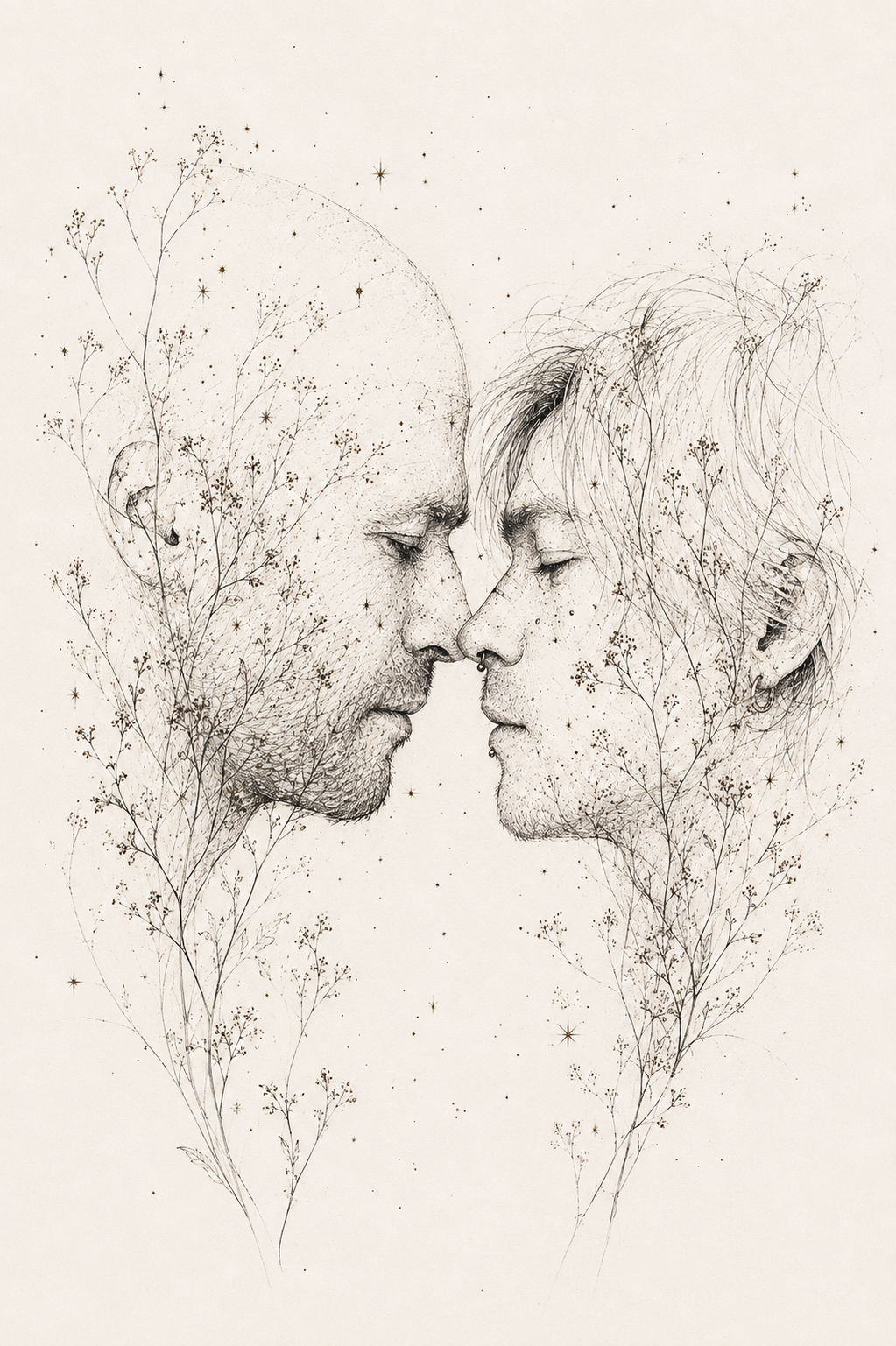
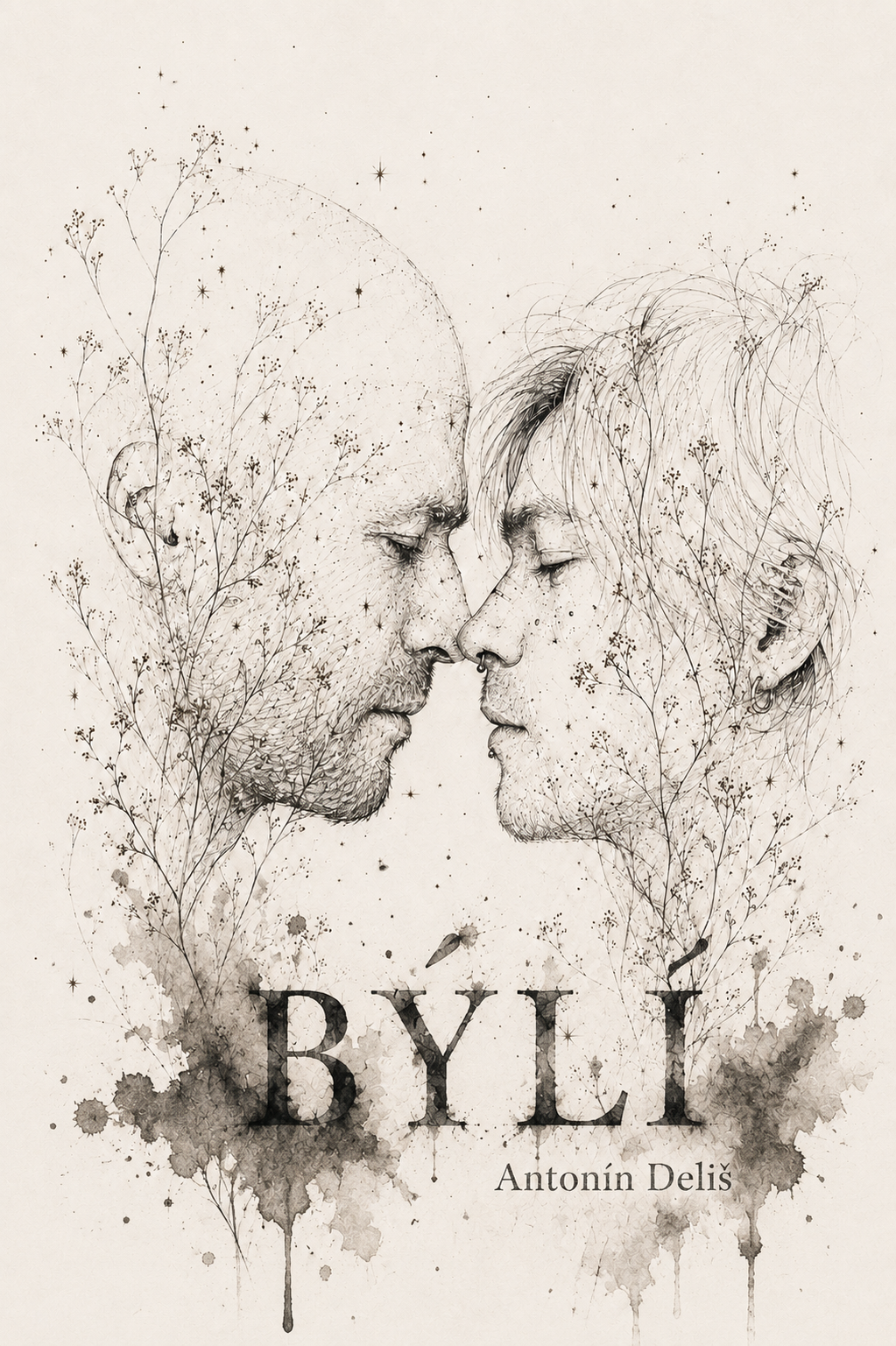
Collection BÝLÍ was created together with its own visual world. The starry sky, dried herbs, a paper star, light coming from the past, and a human face dissolving in the stars are not illustrations of individual poems. They are further entry points into the same space.
How my books are created and published
My books are not published in all formats at once. Each goes through a gradual authorial and publishing cycle.
- I write the book.
A text is born, along with its rhythm, imagery, inner world, and overall authorial context. - A sound world is created.
For projects that call for it, I simultaneously compose music, motifs, songs, or soundtracks. - A visual world is created.
The cover, illustrations, portraits, visuals, and other images are not merely promotion for the book. They often represent another way to enter its world. - I gradually release the music and visuals.
They appear on the website, social media, and, depending on the specific project, also on music platforms. - The book goes to Forendors.
That is where the first previews, work materials, behind-the-scenes content, or the text itself may appear in advance. - The book is getting its own space on Endralon Space.
A page is being created for it featuring the text, context, visual materials, previews, and links. - A printed edition follows.
Depending on the specific book, via a printing platform or other partners. - An electronic version is created.
PDF and EPUB are not just conversions of the finished text. Each format requires its own typesetting, review, and adjustment for the way it will be read. - For selected books, an audiobook or author reading follows.
- In the end, signed author copies and other materials are created.
If they are available for a specific book, I prepare them and send them to readers personally.
What this means for readers
If an EPUB, audiobook, signed copy, or any other format is not yet available for a particular book, it is not a forgotten item.
The book is simply at a certain stage of its publishing life.
I am gradually adding individual formats, music, visuals, and other materials as the whole project matures.
How to order the e-book BÝLÍ
You can order the e-book BÝLÍ directly from the author.
The e-book is AVAILABLE.
Format: PDF / EPUB
Extent: 49 pages
Price: 149 CZK
Upon receipt of payment, I will send you the e-book to the provided email within 24 hours, at the latest within 48 hours.
Bank transfer payment
Account number:
5938542073 / 0800
IBAN:
CZ49 0800 0000 0059 3854 2073
BIC/SWIFT:
GIBACZPX
Please include your e-mail address in the payment note.
If you do not include the email in the note or want to send the e-book to a different address, please write to me after making the payment at:
Please include your name and the time of payment in the message so that I can trace the payment.
Digital product — the e-book is delivered by email. Nothing is sent by mail.
Contact:
wo@endralon.space
Technical data
Title: BÝLÍ
Author: Antonín Deliš
Genre: poetry
Language: Czech
Structure: prologue · 15 poems · epilogue
Thematic areas: love · absence · death · memory · body · time · universe · relativity · light · future
Publisher: endralon.space
About the author
Antonín Deliš is a Czech writer who connects literature with music, imagery, and a cinematic storytelling style. He writes both prose and poetry, returning in his work to the themes of love, memory, the body, loss, loneliness, and the search for a place where one belongs. For a long time, he has been building his own literary universes and often expands individual books with original soundtracks, visual projects, and other layers.
Everything we see in the sky has already happened.
The future has yet to send its light.
Web: endralon.space
Forendors: @antonindelis
Instagram · TikTok · YouTube: Writer's diary
Contact: wo@endralon.space