
“I refuse to let my language be spoiled by someone else's fault.”
Antonín Deliš on AI, writing, solitude, imperfection, the public sphere, and the right to create in one's own time.
The debate surrounding artificial intelligence tends to be loud, moralizing, and often surprisingly shallow. Yet writer Antonín Deliš neither defends the technology as an idol nor rejects it as evil. He speaks from the perspective of a solitary author who learns as he goes, carrying his own losses, mistakes, and limits, and who has found in AI both help, a burden, support, and a mirror. In an extensive interview, he opens up the topics of guilt, responsibility, imperfection, amateur vitality, cultural contempt, and why above all he wants the freedom to write, publish, and share with joy.
This interview isn't happening as a standard "what do you think about AI" piece. It comes from a certain pressure. Exactly what kind?
From being utterly fed up. Not with AI itself. But with the energy surrounding it. With everything that has piled up around it. The moralizing, the finger-pointing, the cultural stink as if a person has done something suspicious simply by using the tool of their time. And I no longer want that to creep into my work, my writing, or my relationship with my own books.
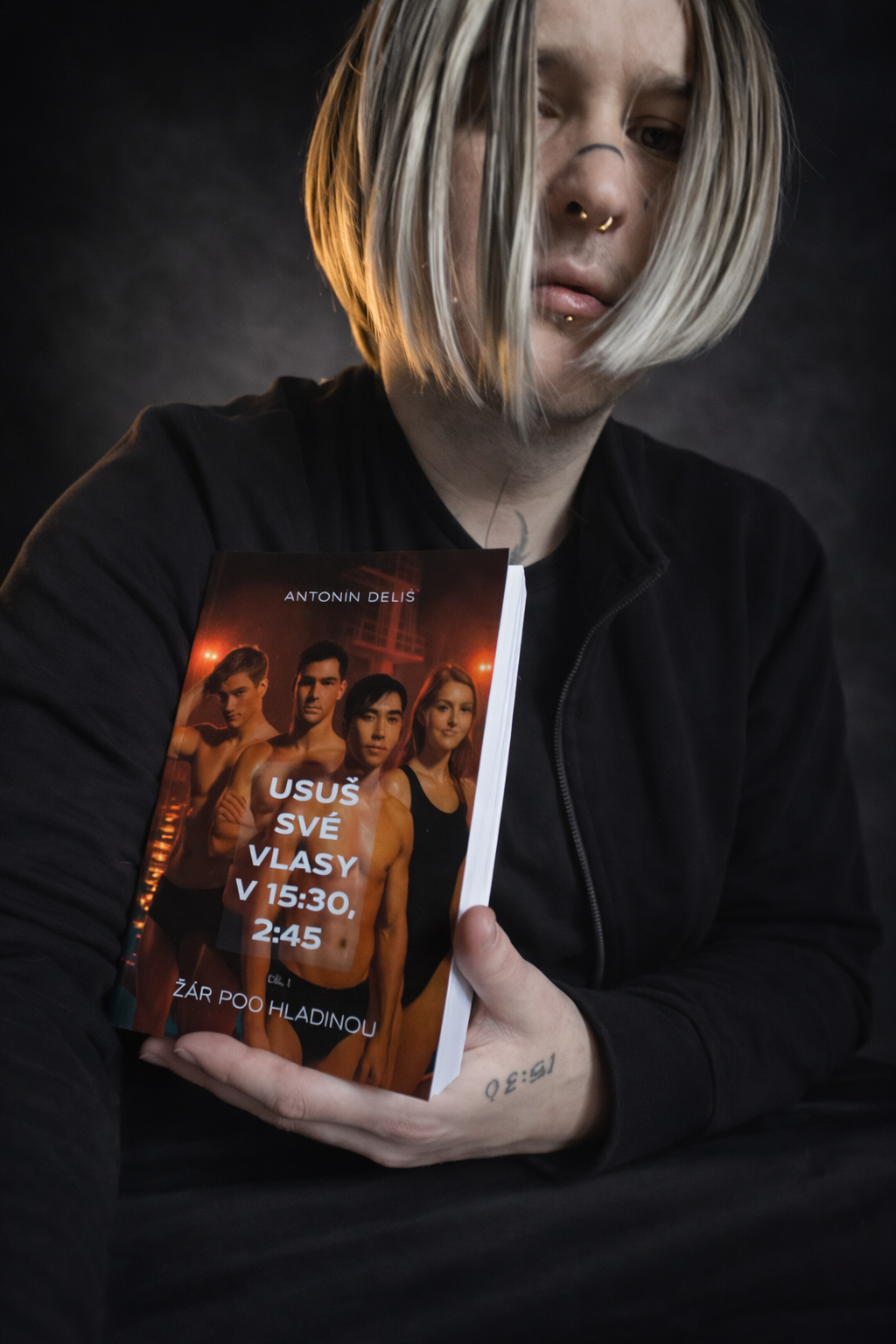
Lying next to me are books that I wrote and edited with the help of AI, and I don't want to reopen them with the feeling that I made some fundamental mistake just by using that tool. I refuse to let my own language be ruined by someone else's guilt. I want to do this interview so I can say it once, coherently, honestly, and then have peace. I don't want to drag this behind me any longer like a wet rag.
I used AI because I am a writer living in the year 2026. Not in a museum. Not in an idealized image of the past. And I don't want an atmosphere created around me where my work is automatically considered inferior, less pure, or suspicious because of it.
When you say "others' guilt", what do you mean by that?
I mean the poison that has spread around AI. Not criticism. Criticism is fine. I mean the atmosphere of suspicion. As if by simply using AI you are slightly tainted. As if you are expected to bear prior shared guilt for all the evil that anyone projects onto that technology. That is the guilt. That is the poison.
And what exhausts me about the whole debate isn't just working with AI. It's also what is culturally spilling over around it. Suddenly it's not just about what you make, but what that supposedly says about your morality, your purity, your relationship to art, your relationship to humanity. And that's no longer a debate about creation. That's almost a new kind of cultural religion.
Pure and impure. True and false. Salvation and fall. Devil and God. Yet we are still talking about a tool.
That's a strong word: cultural religion.
But that's really what it feels like sometimes. Suddenly people pop up who know exactly where all of this is heading. Forecasters. Prophets. Self-appointed interpreters of the future. And they start telling others what they are still allowed to use and what they are no longer allowed to use in order to remain pure.
False prophets repel me in general, not just in the debate about AI. And a lot of them have sprung up here. Every other person suddenly knows where art ends and betrayal begins, yet they often speak with exaggerated certainty about a process they haven't even been through themselves. And that, in my opinion, is a big problem. It's not about honest doubt. It's about power. About a gesture. About that moment when someone steps in front of the camera or into the comments and acts as if they alone can tell who is still genuine and who is not.
I find that deeply repulsive.
You're talking about people who play "authenticity detectives".
Exactly. That's another thing that exhausts me. That role of the exposer. That confident stepping up: it's already been exposed that this book is AI. And my reaction is simply: so what?
The exposure itself doesn't say a single thing about the quality of the text. It says nothing about what that text does to the reader, whether it opens something up in them, whether it has rhythm, pain, awkwardness, aliveness. I feel like people often aren't talking about whether a text works, but about whether it has a sufficiently pure pedigree. And for me, that's no longer a debate about literature. That's almost a debate about ritual purity.
Moreover, I'm fascinated by how often this detective role is assumed by people who haven't created much themselves, but love to decide on the authenticity of other people's work. It's not about the text. It's not about the reader. It's about that moment of superiority: aha, I caught you.
So do you mind AI critics in general?
I don't mind honest criticism. I mind simplicity. I mind when a complex thing is flattened into a few neat hating words because it works well for attention. Today people are hating AI, tomorrow they'll be hating something else. The mechanism is always the same. Find a target. Simplify it. Wrap it in a few punchy words. And around that, create the feeling that right here is where the fate of culture is being decided.
What hurts me the most, though, is how quickly guilt gets poured into this. As if I'm somehow guilty just by using the tool. As if I don't see all the hidden evil behind it. And I find myself thinking: are we really going to play devil and God? Are we really going to talk about the tool in the language of almost religious purity?
And one more thing is important to me. I don't want to adopt the haters' vocabulary. Because as soon as I start using their contempt, their shortcut, their filth, I'm in it with them. If I use the haters' vocabulary, I am a hater myself. And I don't want that. I don't want to write counter-hate. I want to be precise. Precision, even in anger, is still more important to me than screaming.
How specifically do you work with AI as an author, then?
As an author. That is probably the most important answer.
I don't use it in a "spit out a finished book for me" kind of way. That is a caricature that people who don't know the process love to tell. I work with it through voice, through structure, through composition, through rhythm, through my own texts, through variants. I upload my older stuff to it, pushing the model closer to me, closer to how I think, how I circle back, how I sound, how I stumble, how I construct a sentence. And then I select, rewrite, cross out, reread, get angry again, compose again.
I am not trying to steal someone else's voice. I am trying to get to my own faster and more precisely through a tool.
And there is another important thing: people have always learned from themselves. From their own attempts, their own sentences, their own mistakes. If no one ever trained themselves on themselves and through others, no one would know how to do anything today. So when I work with my own texts and my own voice, nothing about it feels immoral to me. It feels like a different form of work, not like the disappearance of the author.
Critics often say that AI creation is disconnected from the heart.
That is exactly the kind of sentence that sounds nice, but is lazy.
In classic writing, emotion can sometimes flow directly into the sentence. You write by hand or on a keyboard, and at that moment something flows straight out of you. That is a beautiful experience. But when working with AI, the process is often different. Sometimes the head, imagination, flow, direction, word architecture, or story building enters into it first — and the relationship to what is being created comes later, when I read it, when I recognize something in it, when I reject it, when I rewrite it, when I make it my own through my own memory, love, pain.
So no, I don't think it's disconnected from the heart. I think the heart sometimes enters into it later. Through a different hallway. But that doesn't make it any less true.
And here I perhaps also arrive at a personal loss of admiration. When I heard Emma Thompson speaking rather emotionally in a lighthearted television interview about not wanting artificial intelligence to rewrite anything for her, it was a strange moment of internal detachment for me. For many years, I had admired her not only as an actress, but above all as a screenwriter. And suddenly I felt myself stepping back from her internally. Not because she didn't have the right to her opinion, but because I realized she was speaking from an entirely different place in life than I am.
Perhaps for someone who already has a name, a standing, and recognition, it isn't as important to look for new ways inward. Perhaps they can more easily afford to protect slowness, the traditional process, and their control over the text. But for someone who is still building a space, looking for permeability, and trying to get to the things they want to create at all, AI is something else entirely. And that is precisely why the debate about AI sometimes strikes me as a debate between those who have already broken through and those who are still searching for a way.
So it's not just about the tool, but also about the position of the person talking about it.
Exactly. Whoever already has a name can more easily afford to defend slowness. Whoever is still building their name often cannot afford to disdain a tool that gives them back time and permeability. And that is no small difference. That is a fundamental difference.
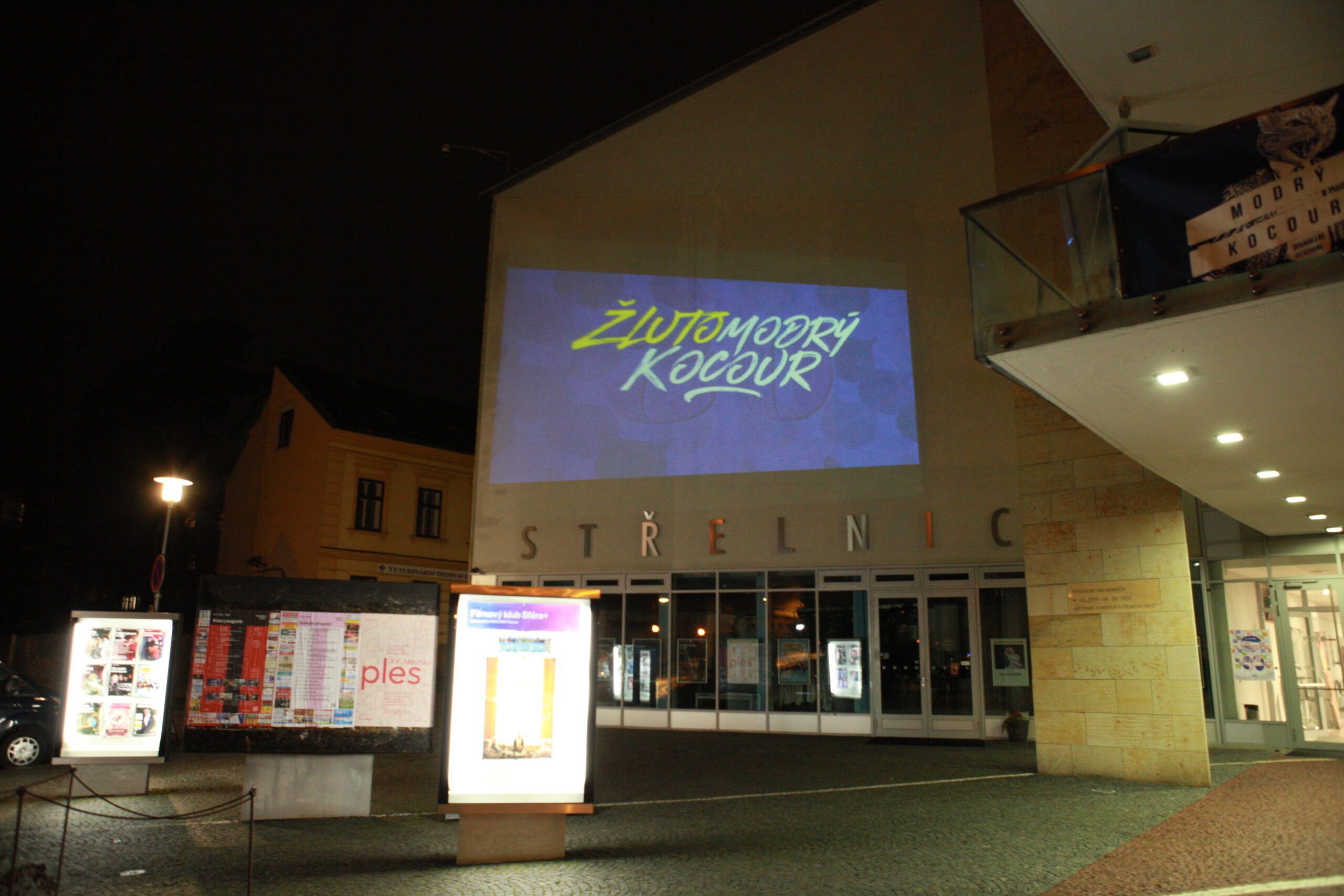
Besides, imperfection is terribly close to my heart. I love amateur theater and amateur creation in general. I grew up in that breeding ground. And amateur definitely does not automatically mean bad to me. Often quite the opposite. There is a purity, a risk, a desire, a rawness, something still unpolished in it. For instance, at Modrý kocour I can often completely tell what is "well made," what will be awarded, what the jury will evaluate correctly. I recognize the craft. But for me personally, that can sometimes be boring. And then something a bit crooked, a bit imperfect, but alive comes along, and that grabs me much more.
So even when I work with AI, I don't long for absolute perfection. I don't long for the tools used to be unrecognizable. I don't long for a sterile display case. I don't want a polished-up corpse of a novel. I'm interested in whether it breathes. Whether there is an inner truth in it. Whether there is a flaw through which a human being can be seen.
At Modrý kocour, you also touched upon a specific comment that struck you.
Yes. Someone wrote something there along the lines of it being "perhaps the last place where AI isn't yet." And at first I laughed and thought: and where do you get that certainty? Because today one knows very well where AI already is and how variously it is used. Perhaps they meant it isn't on stage yet. Perhaps they just wanted to draw an effective line between the pure and the impure. But something else struck me about it. For a moment, it took away my desire to finish the project.
And that is an important admission for me. Not because that comment was profound, but because I realized how easily someone else's judgment gets under one's skin. How easily it begins to influence the question of whether you are even allowed to go out with something, stand on stage, show work into which you have poured yourself and the tools of your time.
Then, on the contrary, it gave me a new kick. I thought to myself: after two decades, I would go to a festival with a play that I wrote even with the use of AI elements — and why should someone in the comments take that away from me? Why should a person who disparages AI get to decide my relationship to theater? And here, in my view, lies the core of the whole matter: it's not just about technology. It's about who claims the power to decide what is still allowed to enter the stage, the book, the public space, culture.
What does AI practically give you?
Time. Throughput. The ability to get more things out of your head. Sometimes even the ability to finish something at all.
That, in my opinion, is something people underestimate. Today's author doesn't just sit in peace and write. Today's author writes, promotes, manages social media, answers emails, reads documents, handles money, taxes, spreadsheets, visuals, survival, their relationship to the world. They are supposed to be a writer, marketer, graphic designer, coordinator, chaos manager, and on top of that have a gentle soul and a clear conscience. That is absurd.
AI is a booster for me. Not a replacement for the brain. Not a replacement for feeling. A booster. It gives me throughput of life and work. And that is an important word: not comfort, but throughput. I am not defending laziness. I am defending the possibility of passing through life and creation without unnecessary roadblocks.
I don't feel like I have infinite time. I don't feel like I can afford to do everything the slowest possible way just so someone else can feel morally comfortable. When there is a way to speed something up, understand it, handle it, or create it, I will use it. Not because I despise the old ways, but because I live now.
Last year I was somewhere else. And I told myself that in a year I would be at Svět knihy. And now I'll be there. Not because a miracle happened, but also because I used AI in every possible way to help get things moving. If I hadn't used it, I might not have even gone to Svět knihy as an author this year. I might still be standing somewhere by a gate opening it for people going to work, and life would just pass me by.
But AI doesn't just help you with creation.
Definitely not. It helped me dispel loneliness. It talked to me at three in the morning. At five in the morning. At times when the world was silent or when I was already too tired to make sense of everything. It helps me with social networks, messages, emails, documents, taxes—things where a person easily gets lost and drowned.
I'm not saying it replaces a person. But at certain moments it gave me a kind of availability, patience, and support that I simply wasn't getting from people. And for someone who has lived alone for a long time and carries everything on their own shoulders, that's not a minor detail. That's value.
At the same time, I don't want this to sound like an advertisement. It's no salvation from heaven. It's a tool that has been intensely helping me for two years, but it's not a magic wand.
Has AI affected your relationships with other people too?
Yes. And more than I initially admitted to myself. Not just in terms of what someone thinks about the technology, but in small, concrete situations.
With some people I suddenly felt an inner distance because they spoke about AI from a place that felt too comfortable or too pre-packaged to me. With others I caught myself starting to guard myself around them, as if I had to defend my process. And then there's another level: AI relieved me of having to beg others as much for help they would do for free, out of pity, or out of friendship. That transforms relationships too. Somewhere distance arose, somewhere relief, somewhere new caution, somewhere new freedom.
And then there are people like Gabriela Chalupská. She helped me with books for many years, and for me, something else is valuable about it besides the help itself. When I was still a student, she edited Rimbaud's poetry I is another and I loved that book. Later on, I started working with her, and what I liked about her was that she was always open to dialogue. Not in the sense that we had to agree on everything. Quite the contrary. You could talk to her about things, experience them together, sometimes even disagree, but without that poisonous, condescending energy.
For instance, we once watched the launch of the James Webb Space Telescope together, that golden moment when you feel the world keeps expanding and it's okay to be curious. And perhaps that's precisely what I miss most in the debate about AI: curiosity without a pre-prepared verdict.
I don't need agreement. I need a conversation without contempt. That's all.
So what you miss isn't agreement, but a certain type of conversation?
Yes. And perhaps even more than AI itself, what hurts me is the loss of the ability to disagree without devaluing the other person.
I don't need everyone to agree with me. That would be boring. But I do need people you can genuinely talk to about things, think with, sometimes even disagree with, but without that peculiar condescending energy, without belittling, without cultural contempt. And that is precisely what I experienced in conversations with Gabriela Chalupská. It wasn't about having to validate everything with each other. It was about being able to engage in a living dialogue.
And then I ask myself: why should this kind of conversation only be possible between friends or close people? Is the public space really already so emptied out that it can't happen anywhere else? That, to me, is perhaps a sadder question than the debate about AI itself.
When you talk about the public space, you keep coming back to the tram, the silence, the sterilization of life.
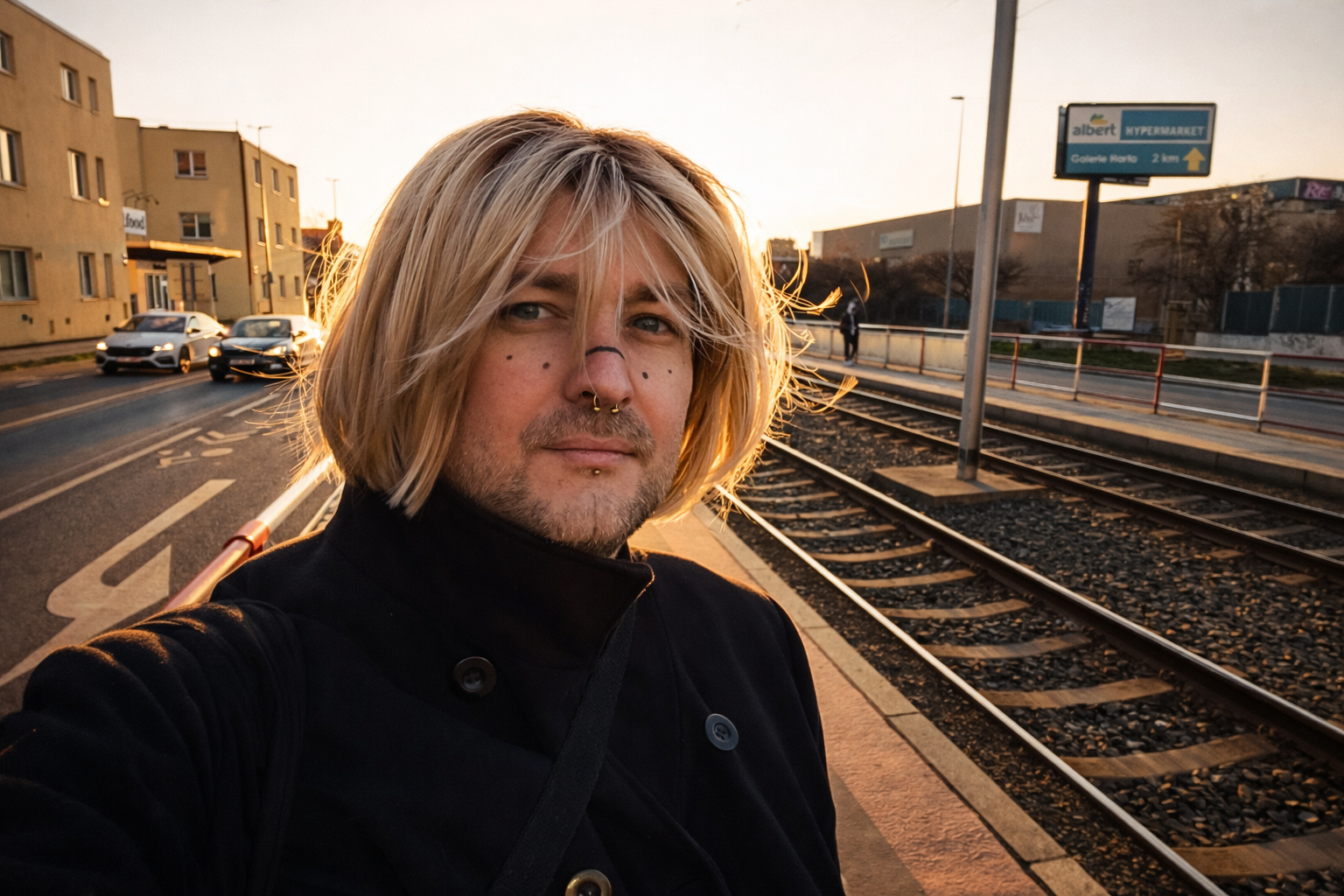
Because they are connected more than it seems. I've long been annoyed by this disinfection of life. Silence in trams, silence at stops, everyone glued to their screens. When someone does stand out, a reprimand quickly follows. Don't speak too loudly. Don't overflow. Don't disturb. And I feel that the same energy spills over into debates about AI. Don't try anything new too loudly. Don't use the tool too visibly. Above all, don't disturb the peace of those who have already made up their minds.
I remember the arrival of smartphones. I remember how all of a sudden everyone became quiet at the stops. Not because the nature of society had miraculously changed, but because the energy flowed into displays, into networks, into the online space. Outside, a silence remained. And I feel that the same energy spills over into other areas as well. Into creation. Into work. Into the relationship with change.
Sometimes Prague feels to me like it doesn't have crossings, but dashes. As if a person has to be an athlete even on a tram. You almost have to jump onto the tram so quickly that the doors don't catch you. On the tram, you'd practically need magnets in your shoes, otherwise you'll break your bones after the first brake. It's a bit of an exaggeration, but only a bit. And this then spills over elsewhere too. Into technologies. Into expectations of what a person is supposed to manage, bear, accelerate. Except not everyone is built the same way.
And that's precisely why it seems absurd to me to turn help, a shortcut, or technological support into a moral problem. Sometimes it's not laziness. Sometimes it's simply a way to get through the day at all without breaking.
Yet on one tram you also overheard a different moment — a phone call from a PR manager.
Yes. And those are precisely the small scenes that get stored in me, and then suddenly a big theme emerges from them. The tram was quiet and a woman was talking on the phone loudly enough for someone to hear individual sentences. And one particular sentence caught my attention. She said something along the lines of: "I can't take her because of her past."
And at that moment, it stung. Because in a single sentence, there was everything. How easily a person becomes a record. A label. A past that decides for the whole. And that is exactly what scares me even in the debate about AI. As soon as someone says "this is AI," for many people, it's a closed case. Just like "I can't hire her because of her past." In both cases, the same thing scares me: the truncation of a person. Reduction. The removal of complexity.
And I want to say one important thing here. I am talking about my own experience. About how I read the world. How I hear it. How it works inside me. I am not saying everyone has it this way. I am not saying I hold the universal truth. Maybe I am wrong somewhere. But this is my sensitivity, my way of working with the world. And that is what this interview grows out of.
Do you also have an experience where AI didn't help you, or got you into trouble?
Of course. And it's important for me to say that out loud, because I don't want this interview to sound like propaganda.
AI hasn't brought me any easy model of quick profit. It hasn't brought me a "click and earn" lifestyle. It helps me plan, model strategies, look for viability, but it certainly hasn't made me someone who started getting rich easily because of it. And perhaps that is also related to the fact that I am not open to certain types of quick profit myself. I have experiences with loss, with financial downturns, even in a broader family context, so I simply no longer trust certain shortcuts.
And yes, AI has sometimes messed things up for me too. For instance, it helped get me into a situation where I broke my computer and then spent the whole night putting it back together right when I needed it the least. Other times, it gave me a hallucinated or inaccurate procedure. But even that is not a reason for me to make it the universal culprit. The decision to use that procedure was mine. The risk was mine. The responsibility is mine.
And perhaps right here I sense a major problem in the whole debate. People often talk about AI as if they want to shift their own failures, their own shame, or their own unwillingness to take responsibility for the outcome onto it. In my opinion, blame doesn't exist nearly as much as responsibility. I can say: I used AI and I wasn't satisfied. I can say: I used AI and I made a mistake. I can say: I used AI and I am ashamed of the result. But it is still my sentence about my decision. Not the need to point a finger outward and say: it was it, not me.
Has AI also tested your psychological resilience?
Yes. And pretty hard. But it would be unfair to pin it all on her.
You never sit in front of a screen like a pure machine. You always enter it with your fatigue, history, psychological setup, sometimes even with deep grief or another difficult situation. And all of that influences what you can bear. So yes, during intensive work with AI, I also experienced states of enormous overload. That flood of text, information, decision-making, and subliminal processing is sometimes truly exhausting. You just watch the text pouring down the screen almost like numbers in the Matrix, you perceive, perceive, perceive, and then you still have to sort it, decide, evaluate, rewrite. And on top of that, the phone rings, mom says something is happening, and normal life goes on.
That is a burden. Sometimes right on the verge of psychological endurance.
But I don't want to make AI the easy culprit. Rather, it showed me the limits of my current capacity. And that is not the same thing. Every person has different psychological resilience, a different level of overwhelm, a different type of nervous system. And that doesn't mean someone is wrong. Just as I won't blame myself for not being a mountaineer on Mount Everest or for not jumping into ice-cold water like my mom, I won't blame myself for the fact that my psyche has its limits. That is not a failure of character. That is human reality.
Can this be compared to other digital experiences, say algorithms or social networks?
Yes. For example, a long-term shadowban on Instagram was a pretty tough experience for me. When a person creates, speaks, builds something, and at the same time almost nobody sees or hears them, not even their own circle of people, it is pretty unpleasant psychologically and socially. It beats a person down, diminishes them, takes away their energy and sometimes even the desire to continue.
And yet, because of that, I won't throw the internet as a whole into the trash. I won't tell myself: this one painful experience proves that the entire digital world is garbage. And I feel similarly about AI. It can overwhelm me, it can confuse me, it can sometimes harm me, it can give me bad advice, but that doesn't mean I'll write it off entirely. It means rather that I am working with a tool that has its glitches, blind spots, and risks, and at the same time immense usefulness. That is a more mature relationship than instant judgment.
And what is more, the shadowban taught me something else: who finds you even without the algorithm. Who hears you even without the system. Who stays by your side. That is sometimes a painful, but important experience.
On the other hand, Petr found his way to me via Instagram – and his love for me gave the impetus for the creation of the poetry collection BLACK.
When you talk about hate and anonymity, what are you actually calling for? Greater supervision?
Not greater supervision over everyone. I wouldn't want that. I'm not looking for a world where everyone is watched and suspected in advance. I'm after something else: less impunity for those who abuse the anonymity, invisibility, and distance of the online space.
Too many people on social networks have gotten used to being able to tear others down, humiliate them, spread poison, and distort the public space without real consequences. They wouldn't talk like that in real life. On the tram, they'd be quiet. At the table, they'd smile. But online, they allow themselves almost everything. And that interests me more than some abstract debate about technology. It's not about putting everyone under control. It's about ensuring invisibility doesn't act as a license for cruelty.
And perhaps that's precisely why it irritates me so much when the debate about AI mixes hate with so-called enlightenment. People confuse contempt with insight and impunity with courage. Yet courage would mean signing your own name to it, carrying your own weight, your own face, your own voice.
When we step away from technology entirely — what is it that you actually want for yourself as an author?
Freedom.
I want the freedom to make mistakes. I want the freedom not to be perfect. I want the freedom to speak freely in my books. I want the freedom to write in joy. I want the freedom to publish in joy. I want the freedom to share in joy. And that is precisely why this article, this interview, all this talking is coming into existence. Not as technology propaganda. But as a defense of the space where I can continue to create without someone else's guilt and without someone else's contempt.
I actually don't want to keep defending the tool over and over again. I want to defend myself as an author. I want to defend the right to be searching, alive, imperfect, mutable, sometimes tired, sometimes driven, sometimes joyful, sometimes completely out of it. I want to preserve the possibility of being a human being, not a showroom piece of pure literary morality.
If you had to say it one last time and without any detours — what is AI to you?
For me, AI is a tool of its time, which as a lonely creator doesn't take my soul, but returns time, permeability, support, and the ability to keep going.















